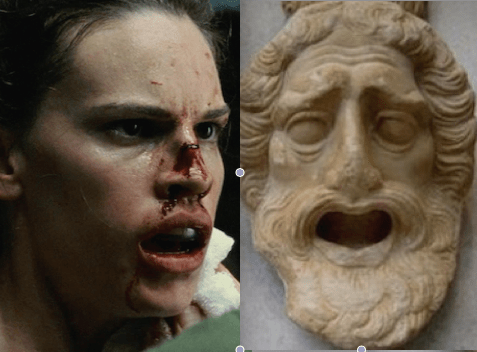
When Clint Eastwood, an actor, producer and director of Million Dollar Baby (released in 2004) was asked what the film was about, his answer was: “the American Dream”.
Maggie Fitzgerald, a 31-year-old woman from a poor and backward part of America, is determined to train as a boxer. She manages to convince Frankie, a talented trainer, to coach her. He teaches her various techniques, constantly stressing that the first rule is always, absolutely always, to protect yourself. After she wins many fights he arranges for a million-dollar match. She almost wins, but as the round ends she carelessly turns her back to her rival, who then punches her from behind. She falls on her stool, breaking her neck, and is left a quadriplegic. Frankie, now deeply attached to Maggie, is devastated. He stays by her side, trying to rehabilitate her. But after her foot is amputated she asks him to help her commit suicide. Horrified, he at first refuses, but later accepts her wish and kills her. After her death he disappears.
In the second part of the film, after Maggie’s unexpected fall, it is useless to struggle with the tears. The spectators are swept up by sorrow as they see the strong, free-spirited female boxer turn into a complete invalid; it is almost impossible to imagine how she feels. Exactly as Aristotle defines tragedy, “arousing pity and fear”, the viewers are overwhelmed with compassion and horror, thinking that this could happen to them too. When the film ends, the effect of the cathartic moment is apparent: “Thank god I am not paralyzed!”
In the making of this film, Clint Eastwood follows closely most of the principles of ancient Greek tragedy. First, it deals with comprehensive themes – love, pride, loss. The protagonist, a tragic hero, commits either a crime or a mistake, often without acknowledging how foolish and arrogant he has been. The nature of his crime is often related to hubris, to vanity. He then slowly understands his mistake, as his world crumbles around him. And also – the tragic hero is essentially a good man. The downfall of a villain would not produce the desired effect of horror and pity. But witnessing the complete destruction of a good man is heartrending and terrifying.
In Million Dollar Baby, Maggie, the protagonist, totally wins our hearts. Her determination and courage, together with her honesty and devotion to her family, make her utterly lovable. She convinces Frankie (himself also a tragic hero) to coach her. He makes her repeat over and over again that the first rule of boxing is to always protect yourself! Her ongoing success, the tough opponents she overcomes, the cheering crowd, all make her self-confident, to a point where she becomes careless. In a single moment of hubris, she makes the hamartia, the critical mistake: she turns her back to her opponent, who then strikes her and she falls.
As in every Greek tragedy, fate plays a crucial part. Maggie could have fallen in the ring; but as she falls, her head bumps into her stool and she breaks her neck. This peripateia – the unexpected turn of events – reroutes the plot to an altogether different direction. Lying paralyzed in bed, she acknowledges her mistake: I didn’t protect myself, this was my mistake, I didn’t follow Frankie’s orders. The audience reaches a full catharsis in the moving final dialogue between her and Frankie and the last kiss before he takes her life.
There is, however, one central feature of Greek tragedy that Eastwood completely ignores. The vast majority of Greek tragic protagonists are people of the upper class. Million Dollar Baby is a film about lower-class Americans. The boxing club is a run-down gym in Los Angeles; Maggie lives in a shabby room and works as a waitress in a diner, from which she takes left-over food to eat at home. She has come to Los Angeles from a god-forsaken town. Her overweight mother makes a living from deceiving the social security; her brother is in jail. There is absolutely nothing noble about poverty in this film; it is ugly, vulgar, and callous.
So for what sin is Maggie punished? From a modern perspective, she is trying to fulfill the American dream: to overcome her poor background, to surmount the pettiness of her family and a sense of purposelessness, to achieve the impossible: to become a successful boxer at the age of 31. In simple, everyday words: she wants to make it.
But she fails.
Her depiction in the context of a Greek tragedy illuminates her character in heroic tones, making her comparable to classic protagonists. According to Eastwood, the exhaustive, back-breaking – and yes, valiant — efforts of lower-class Americans to succeed are bound to fail. They can either accept their poor condition or end in self–destruction.
The American dream is, indeed, only a dream.
 Emanuela's Blog
Leave a comment