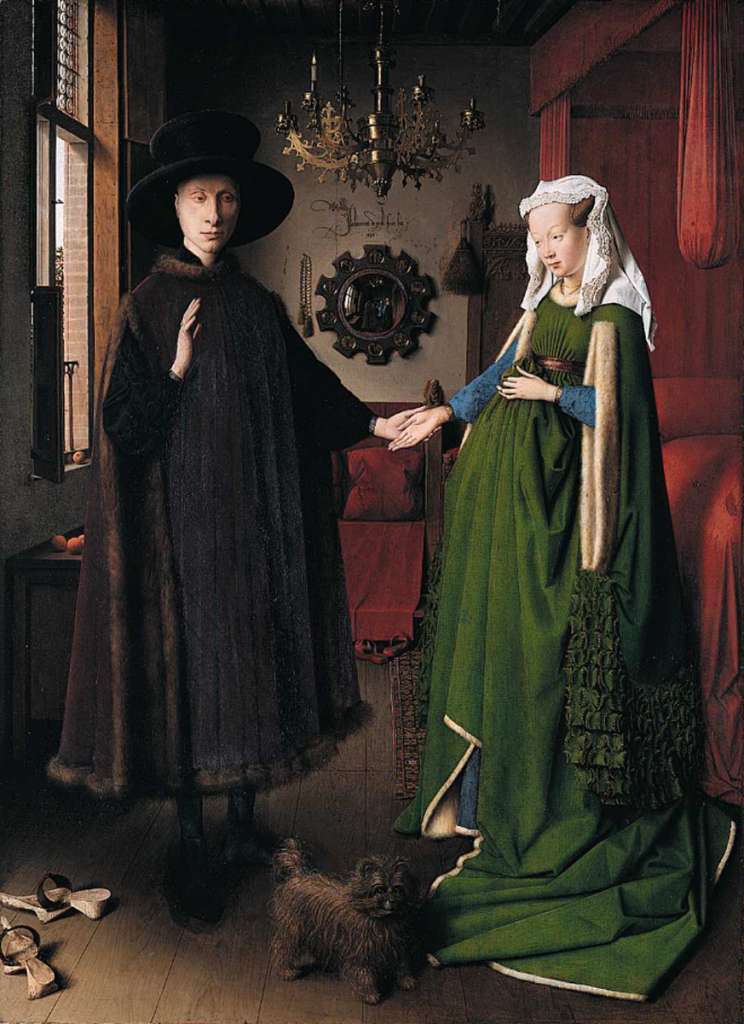
There are some enigmas that never cease to challenge the world of art history. One of them is a small picture, a masterpiece by Van Eyck dated 1434, often referred to as ‘The Arnolfini Portrait’. It is generally believed that the man in the picture in a member of the Arnolfini family, wealthy Italian traders who lived in the Flemish city of Bruges.
Looking at the picture, one cannot understand what the man and the woman are doing; he is raising his hand in a ceremonial manner, they stretch a hand towards each other, not quite holding hands. In addition to the man and the woman, two people are reflected in mirror behind them, and there is a strange huge autograph of the painter: Jan Van Eyck was here.
Several art historians tried to find a plausible explanation for this portrait. The masterful scholar Ervin Panofsky had published an article at the Burlington Magazine in 1934 arguing the picture is a legal document denoting Arnolfini’s wedding: the position of his left hand is that of taking a wife, and the position of right hand symbolized the act of marriage. The two people in the back are the witnesses; perhaps one is the artist, who therefore signed the picture with huge letters. Other art historians disagree, providing various possible explanations: it is a betrothal, not a marriage; the woman only appears pregnant, but it was a fashionable dress at the time; Arnolfini is granting his wife legal rights; it is another member of the Arnolfini family, since this lady died before the painting was created; this may be a painting in memory of Arnolfini’s wife; this is an unknown wife of one of the Arnolfini brothers; we cannot be sure it is a member of the Arnolfini family. And there are scholars who believe the iconography of the painting has no particular meaning, it is simply a woman and man in an unusual position.
I saw photos of The Arnolfini Portrait several times; but as I was facing the painting itself, as if often the case, new emotions and observations were created. I had a strong notion that there is a fundamental difference between the countenance of the man and the woman. After many deliberations I came to the conclusion that Arnolfini, the man, isn’t looking anywhere, whereas his wife’s look is rather focused. If I was examining the painting without knowing the various interpretations I would say Arnolfini was blind.
Following this hypothesis would lead to an altogether different interpretation of this masterpiece: it is a subtle yet apparent description of blindness. Arnolfini is stretching his right hand to his wife without being able to see her hand. Therefore they don’t hold hand as would be expected, but their hands are touching in an unusual way. This is Van Eyck’s artful manner of demonstrating that Arnolfini can’t see her hand.
The mirror in the back exhibits two people present in the room, yet they cannot be seen directly. Is it possible that Arnolfini himself is unaware of their presence?! Perhaps it is simply a way of directing the spectators’ attention to the question of who can see whom.
Since it is daytime, the one candle lighten in the chandelier is clearly unnecessary, unless it is symbolic of vision that is lacking. Even Van Eyck’s huge signature, with the strange inscription – that he was there – may reveal a need one feels when standing next to a blind person: to speak louder, to touch him or her, to make noise whilst moving around the room, or, in short, to make one’s presence more noticeable.
It is true that the painting doesn’t follow the accepted gestures denoting blindness in art: head leaning backward, closed eyes, eyes lacking pupils or irises, using a walking stick. But all these are typical of an earlier time, and even then, there are examples in which blindness can be detected only by a person’s facial expression.
My father, Moshe Barasch, an art historian, had written a book on blindness in art, titled Blindness. On its place in fifteen and sixteen centuries he says, “Blindness is not a central theme in Renaissance imagery. Neither in literature nor in visual art is much paid to the sightless person… the persons deprived of it are marginal, often nonexistent”. Van Eyck in not depicting a metaphorical blindness or a spiritual one; this could simply be a picture, one could say a modern one, of a wealthy merchant who cannot see
If, indeed, the man in the picture is blind, what is it that he is doing? If I had to guess, I would say he is anxious of the approaching childbirth, fearing perhaps that the child will be also an invalid. Could he be taking an oath that if the child would not be blind he would donate sparingly to the city or to the church? His wife seems anxious too, almost fearful of the future. There are two witnesses to this oath, and a signature of Van Eyck. May God give me a healthy baby, able to see the world.
 Emanuela's Blog
Leave a comment