Author: Emanuela Barasch Rubinstein

  • A Crazy Pioneer

    A Crazy Pioneer

    The history of Zionism was written by men, no doubt. Its ethos is abundant with daring masculine pioneers and brave soldiers sacrificing their lives for the Jewish state. Also, the prevailing notion of a strong, self-defending ‘new Jew’ was closer to the popular perception of masculinity, making the aggrandizement of heroic men almost natural. But some women played a substantial role in the development of Jewish life in Palestine, later Israel. Unfortunately, they were deprived of their proper place in history books, in the past and also today.

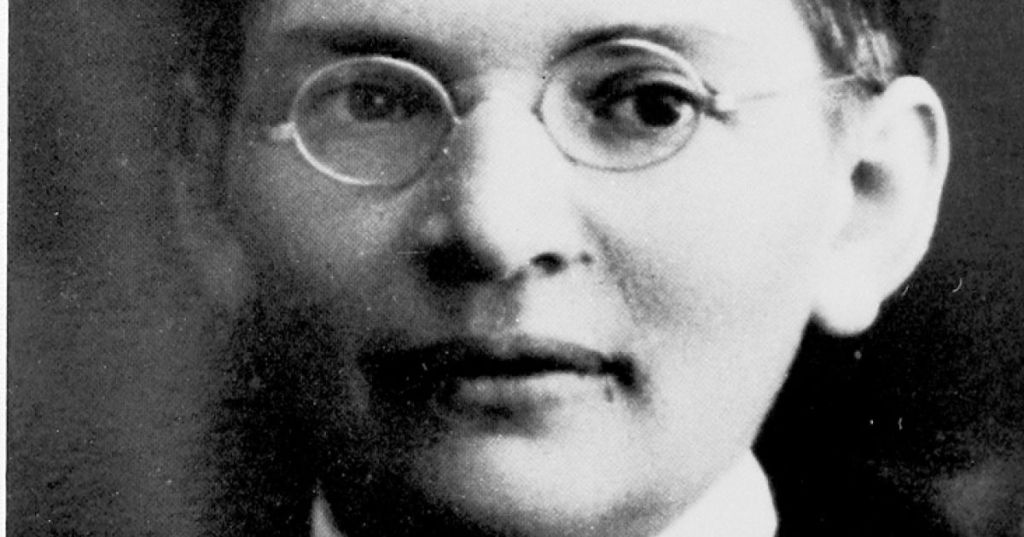
    One cannot overestimate the importance of the Kibbutz, the collective settlement traditionally based on agriculture, in the history of Zionism – an idea initiated and exercised for the first time by Manya Shochat (1880-1961). Born in Grodno, part of the Russian Empire, she was the eighth daughter of ten children. Her grandfather was one of Napoleon’s soldiers who remained in Russia, converted to Judaism and married a Jewish woman. They were secular middle-class Jews, but their son, Manya’s beloved father, became an orthodox Jew, creating an open rift with his parents. Like other family members he was prone to depression and suicide. His parents tried to prevent his turn to religion, but gave up after he tried to take his life.

    Manya’s character could be described as a blend of depression and suicidal inclination with a tendency to act in imaginative, unconventional ways. Already as a child her uncontrolled moods made attending school impossible. As a teenager she escaped home and, wearing men’s clothes, found a position as a porter. She later became a carpenter in her brother’s factory, a profession from which women were completely excluded in those times. Manya was deeply touched by the suffering and poverty of the workers around her and fully adopted socialist ideals. She joined the Bund, a Jewish revolutionist socialist movement, and later founded a Jewish Labor Party, which collapsed in 1903. Broken-hearted and depressed, she accepted her brother’s invitation to visit Palestine.

    Like other pioneers before her, Manya fell in love with the land. She joined her brother in a tour looking for water and minerals, riding a horse from the Galilee to Jerusalem, to the Judea desert, and then to the south. The journey of the brother and sister, with two friends, lasted weeks. Manya cut her hair short; the two women dressed like men. She later said it was difficult to ride a horse with a long dress, but no doubt her appearance betrayed resentment against feminine embellishment. It illustrates well the nature of socialist feminism – focused on the social and economic oppression of women, and not on feminine identity and self-perception. Manya wished to work like a man and wear men’s clothes. Only once, as a child, did she want a velvet dress, but she was too embarrassed to ask for it.

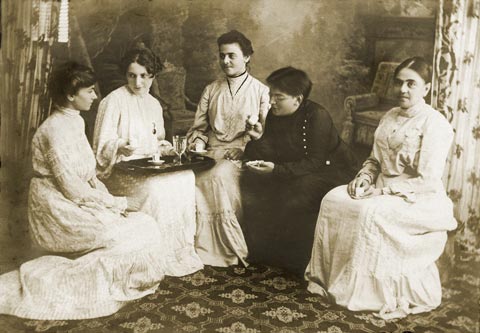
    The journey in Palestine pulled her out of her depression and she decided to stay, giving up her hope to be part of the socialist revolution in Russia. She wished to implant socialist ideas in the future Israel. Yet some Zionist pioneers already living in Palestine saw her as an imbalanced – not to say deranged – woman, with bizarre ideas of equality between people. But she didn’t give up her well-defined plans. In 1908 she was the one to initiate the first experimental collective farm in Sejera, in the Galilee, on land purchased by Edmond de Rothschild. This collective community was, in fact, the first Kibbutz – a unique way of life that made a substantial contribution to Israeli society.

    Manya married Israel Shochat, a handsome man and one of the founders of the first Jewish military organization. Together they ran Sejera. Within a couple of months the collective community had eighteen members, six of whom were women, wearing pants and working in the fields with a pistol tied to their belt. There was something of a fraternity about this group of young people: the common jokes, a spirit of non-conformism, physical and mental strength, a profound knowledge of agriculture. Together Manya and Israel set the major principles of Israeli society in its first decades: military self-defense and socialist communities.

    Manya was not oblivious to the Arab-Jewish conflict; her attitude towards the Arab communities was ambivalent. As a socialist, she was eager to advance social unions among the Arab population. As a Zionist she couldn’t help but admit the conflict of interest between the Jewish pioneers and Arab villagers and Bedouins. Yet she often demonstrated her fascination for the local Arabs – conducting long conversations whenever possible, paying them visits, and even attempting to adopt their daily habits.

    With the foundation of the State of Israel, other leaders replaced Manya and Israel. She joined another kibbutz; he moved to Tel Aviv, leaving her with two children. Her son, a pilot in the RAF and one of the founders of the Israeli Air Force, committed suicide in 1967. Her daughter lived in Australia. But Manya, in spite of her suffering, remained unchanged: struggling with depression, finding solace in decisive action, and always looking for innovative ways to create a better society.
  • Bewildering female Nude

    Bewildering female Nude

    The perception of the female body is one of the most intriguing and controversial questions of the modern age. Painters, sculptors, photographers have all tried to portray it in insightful and innovative ways: realistically, impressionistically, as an object of desire, as decoration, as an abstract idea; there are endless depictions of nude women, each unearthing a new, unfamiliar aspect. Strange that a thing so familiar – either our own body or that of a partner – remains a mystery that constantly requires explanation. What is it about a woman’s body that evokes this drive to interpret it?

    Henri Matisse (1869-1954), a French painter and sculptor, was one of the artists who shaped twentieth-century art. Active for nearly six decades, he left a huge and versatile body of work. His firm belief that art should constantly be changing made him explore with colors, shapes, light and shade. Often changing his style, and followed by other artists, he was a leading figure in modern art.

    I admit I find his works rather intriguing; people are deeply impressed by paintings that seem to betray a conscious attempt not to gratify the spectators. His works are focused on the process of making art, and at times seem to completely ignore its viewers. They are very expressive, using colors in a unique manner, but not in ways that attempt to please the eye.

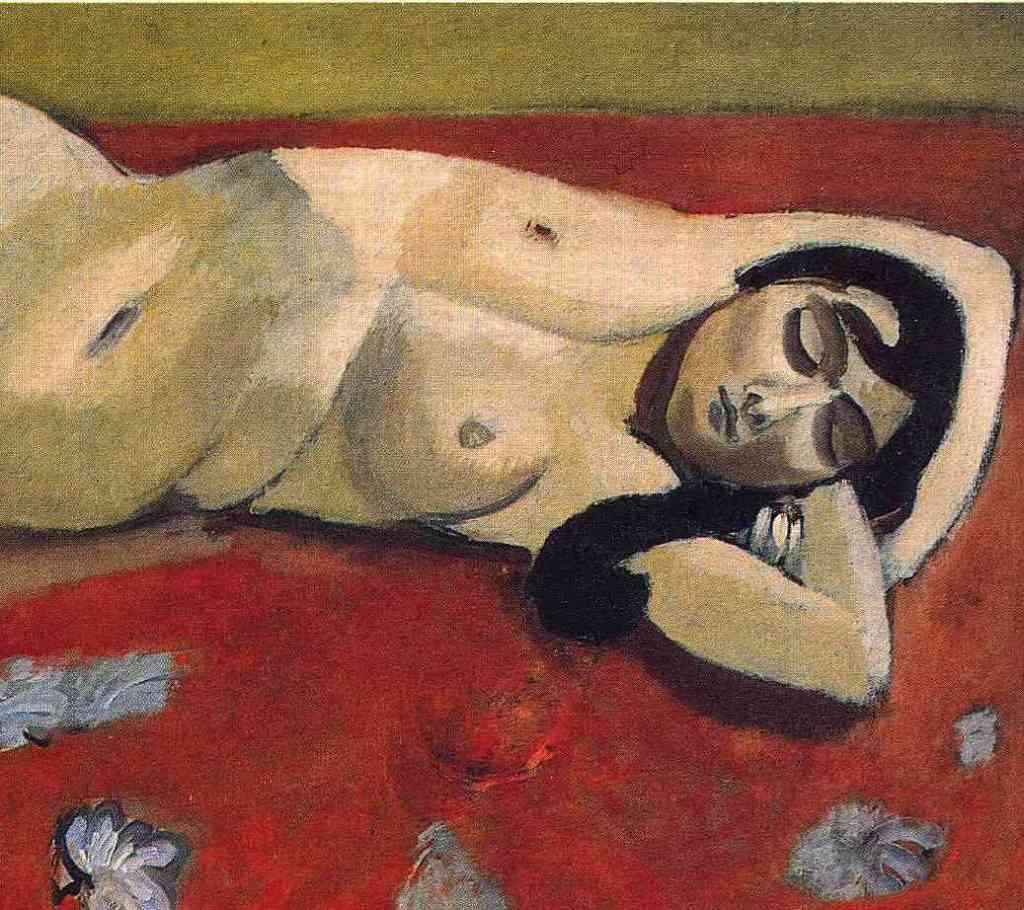
    Sleeping Nude on a Red Background was created in 1916. Art historians divide his creative years into periods: the early years, Fauvism, the embattled artist, the time he spent in Venice, the Soviet Union, America, his last years. 1913-1917 were highly experimental years, during which he pursued a radically new and inventive approach to artistic production. It has been argued that during this time he made the most challenging experiments of his career. In 2010 the MoMA and The Art Institute of Chicago held a joint exhibition devoted to these years, titled “Matisse: Radical Invention, 1913-1917”.

    Describing himself, he defined his artistic work as “the methods of modern construction”, not only in terms of experimental techniques but also as a way of defining modernity. What does it mean to be modern? In these experimental years he made various attempts to portray the unique qualities of the modern worldview.

    There is something disturbing about Sleeping Nude on a Red Background. The model’s pose, a naked woman recumbent on a cloth, is consistent with the artistic tradition of a female body leaning against a fabric. Yet Matisse’s model has two conflicting qualities: on the one hand, parts of her are poster-like, lacking any depth. The black hair, the pubic hair and the black object in the back look almost as if they had been made with a black marker. Her body, on the other hand, is vibrant and realistic, in particular her abdomen, which may even suggest movement. But strangely, a careful examination reveals that the colors of her body “spilled” underneath her. It isn’t shadow but an extension of the body onto the sheet.

    Students of Matisse often refer to the innate ambivalence of his work: the past blends with the future, the depth of traditional art is combined with the flatness of modern art, figures of the past mix with the decorative nature of contemporary art. The art historian Alastair Wright argues that “his work sat on the knife-edge between the representational tradition of the nineteenth century and the formalist abstraction to come.” His attempt to define modernism can be extended to include an examination of the modern perception of the female body.

    On the one hand, the sleeping woman is merely an object: the hair and the pubic hair are of the same quality, like something placed there, in the background. She is very beautiful, but still, an object. On the other hand, her body seems so real, almost like an untouched photo of a woman her age, sleeping on a couch. In fact she is so ‘real’ that her vitality seems to spill beyond her contours. The fleshly aspect is very authentic, so sensual that it overflows her body. She is the embodiment of the modern dual view of the woman’s body: as both a sexual object and a liberated person, physically and emotionally.

    I wonder if this ambivalence prevents the eradication of the sexual objectification of women. Is female nude a manifestation of sexual exploitation or of liberation of women? Ambiguity is very difficult to overcome. If a woman’s body was only an object, it probably would have been easier to struggle with it. But this vague, unequivocal attitude – sometimes naked women are merely sexual objects, sometime nudity is one aspect of women perceived as whole human beings – is hard to defy. It certainly is a “modern construction”, as Matisse had put it. And deconstructing it is very difficult.

    Sleeping Nude on a Red Background is exhibited in Kunsthous Zürich.

    This article was posted on the Kunsthous Zürich Museum’s Facebook page on September 22nd 2015.

  • Ruth Schloss – Artist, Socialist, Israeli

    Ruth Schloss – Artist, Socialist, Israeli

    German Jews who immigrated to Israel in the early twentieth century made a huge contribution to the Israeli culture. Yet too often they were deprived of the appreciation they so highly deserved. This may have been a result of them lacking the Zionist zeal of East European Jewry, or maybe their adherence to the European intellectual spirit made them a bit alien in the Israeli society that was forming, driven by the anti-intellectual image of ‘The New Jew’.

    Ruth Schloss (1922-2013), an Israeli painter and illustrator, was born in Nuremberg to a fully assimilated Jewish family. Her parents, wealthy paper merchants, raised her in a progressive, liberal ambiance, with an enhanced social awareness. Her father, though himself an employer, used to march on International Workers’ Day carrying a red flag. Her mother established a liberal nursery school, where her daughters were among her students; she covered the walls with papers and encouraged the children to draw on them as much as they wished!

    Only at the age of eleven did Ruth discover that she was Jewish. In 1933, rising anti Semitism and the Nazi takeover of the government made her parents realize they could never be part of the German society they so dearly cherished. The family decided to immigrate to Palestine. First went the father, then the mother and the daughters. When Ruth arrived in Palestine, she didn’t speak a word of Hebrew, and had only a vague idea of both Judaism and Zionism. The father decided to abandon his former profession and become a farmer. They settled in Kfar Shmariahu, then an agricultural farm, now one of the wealthiest neighborhoods in Israel; they did rather well in their new occupation.

    Already as a child Ruth was inclined to the arts, determined to become an artist. But in Palestine, without any Hebrew, she made a most unusual choice: instead of going to high school she applied to Bezalel, an art college where classes were given in German, as the teachers themselves were recent immigrants to Palestine. She was admitted at the age of fifteen. All by herself she moved to Jerusalem, renting a tiny room, steeping herself in the study of art. At the age of nineteen she graduated with honors.

    After her graduation Ruth joined a kibbutz, a collective community. Though she had grown up in a capitalistic environment, her parents’ pronounced social sensitivity made the move to a socialist society natural, almost expected. She fully adopted the ideal of the kibbutz – complete equality between members in all respects – feeling that this was the only way to provide for the weak, the deprived, the unprivileged.

    At a certain point in Israeli history, segments of the socialist movement felt that Israel should become part of the Communist bloc, rather than seek the support of the western world. This was not only a practical political issue but a disagreement on the future nature of Israeli society. Ruth and her husband, the historian Benjamin Cohen, were fierce supporters of the Soviet Union. In a bipolar world of western countries vs Communism, expressing a decisive ambition to be part of the Soviet Union led to their expulsion from the Kibbutz. They moved to the center of Israel, and joined the Communist party, whose members were both Jewish and Israeli Arabs. The couple lived in Kfar Shmariahu, where they raised their two daughters.

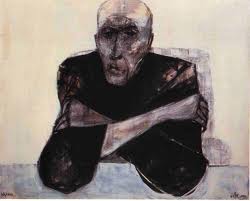
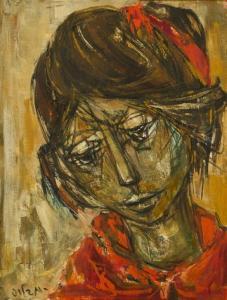
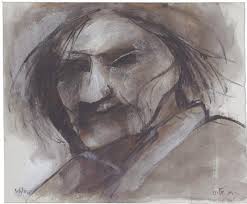
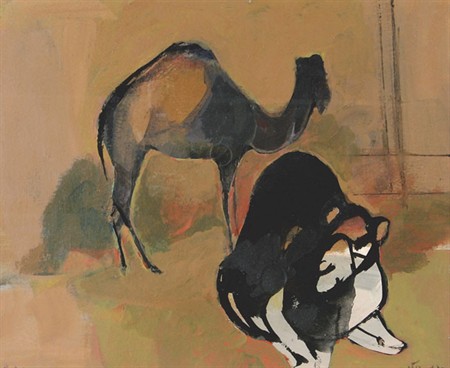
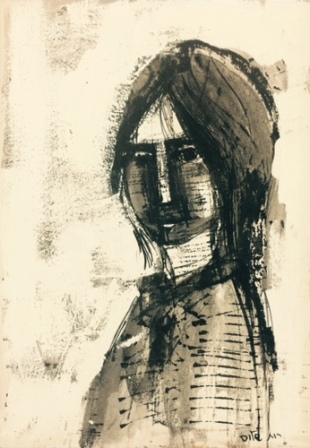
    In contemporary eyes this adherence to extreme socialist ideas may appear odd, even hypocritical. But Ruth’s sketches and paintings reveal where her dedication to social justice was coming from. Almost all her works depict old people, cripples, refugees, exhausted mothers, neglected children, – even animals in pain. Her compassionate nature made her see, perhaps in a distorted manner, the weaker members of society. To make a living she illustrated children’s books. She often complained that this called for a naïve, light depiction of reality, whereas her natural inclination was to describe the darker aspect of human existence.

    Not only her German background and political stands deprived her of her worthy place in Israeli art. Mostly it was her unique artistic style that made art critics devaluate her work. Her figurative style and focus on human suffering was contrasted with the prevailing artistic inclination to abstract art. Yet she found abstract painting limited, unsatisfying, confessing that she could not truly express herself without a focus on a concrete subject. It never occurred to her that she could adapt her art to the modern, contemporary style. Her motivation, both moral and artistic, was to provide a realistic presentation of segments of our life we normally don’t like to see.

    Ruth Schloss never had an exhibition in the major Israeli museums. Her works were presented in private galleries and small museums. Sadly, her paintings and sketches are now auctioned. It is my humble opinion that her art is worthy of an exhibition in the best art institutes in Israel.

  • A Jewish State of Mind

    A Jewish State of Mind

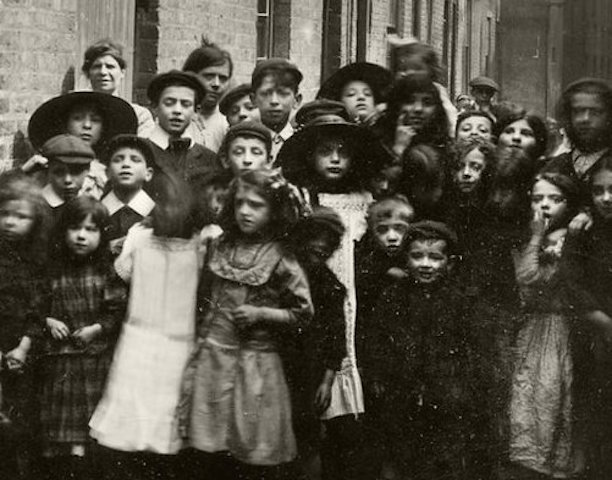
    Sometimes reading a book creates a feeling of ‘recollection’. Something about the atmosphere, the use of certain words, the depiction of daily life, seems so familiar, almost as if we have actually been there, in a different time and place. When I read Israel Zangwill’s Children of the Ghetto: a Study of a Peculiar People, I felt this way. In a way, the spirit of my parents, who immigrated to Israel from Eastern Europe, was similar to the state of mind depicted in the novel. Alongside their intellectual engagement, they also had these inclinations to be down-to-earth, to cling to common sense, to cope with hardship through humor. I find Zangwill’s portrayal of the Jewish mentality prevalent in East London in the late nineteenth and early twentieth centuries astonishingly familiar.

    Israel Zangwill (1864-1926), the “Dickens of the Ghetto” as he is sometimes called, a British writer and humorist, was born in London to Jewish immigrants from eastern Europe. He went to school in East London, where education was free, and later became a teacher, journalist, author and political activist. He married Edith Ayrton, a non-Jewish author and feminist, and openly encouraged the feminist struggle. Zangwill was also involved in the Zionism movement, supporting the foundation of a Jewish state, though not necessarily where Israel is today.

    In his literary work he describes the life of Jewish immigrants, both in London and in the United States. Children of the Ghetto: a Study of a Peculiar People is a wonderful, rich, deep and humoristic description of the Jewish immigrant community in East London. The colors and spices of the ‘exile’, the Diaspora, are all there: the Yiddish language, the abstemiousness born of poverty, the inbuilt skepticism, shabby appearance, and above all, humor, which alleviates any suffering. But Zangwill also adds some observations on the nature of the Jewish people, a ‘peculiar people’, as he puts it.

    “People who have been living in a Ghetto for a couple of centuries are not able to step outside merely because the gates are thrown down, nor to efface the brands on their souls by putting off the yellow badges. The isolation imposed from without will have come to seem the law of their being.” Centuries of forced isolation from the non-Jewish environment created an inner seclusion. Of course, in London Jews could live wherever they wanted. But they had already internalized a sense of being essentially different from others, though not in a negative manner: “For the Jew has rarely been embittered by persecution. He knows that he is in Goluth, in exile, and that the days of the Messiah are not yet, and he looks upon the persecutor merely as the stupid instrument of an all-wise Providence.”

    Life in the Ghetto was anything but pomp. The synagogue provoked no sense of intimidating awe: “Decorum was not a feature of synagogue worship in those days, nor was the Almighty yet conceived as the holder of formal receptions once a week. Worshippers did not pray with bated breath, as if afraid that the deity would overhear them. They were at ease in Zion.” Yet this lack of distance from the divine – people often talked business in the back seats of the synagogue – went hand in hand with an affinity with ‘the Almighty’, a sense that Providence is concrete and tangible.

    Perhaps the most palpable feature of Jewish life Zangwill depicts is the granting of immense importance to satisfying life’s simplest needs. Not that emotional and spiritual inclinations did not matter; they did, but always after food and shelter were ensured. When describing the signing of an engagement contract, Zangwill writes “As a nation, Israel is practical and free from cant. Romance and moonshine are beautiful things, but behind the glittering veil are always the stern realities of things and the weaknesses of human nature. The bridegroom, Pesach, … was a boot-maker, who could expound the Talmud and play the fiddle, but was unable to earn a living. He was marrying Fanny Belcovitch because his parents-in-law would give him free board and lodging for a year, and because he liked her. Fanny was a plump, pulpy girl, not in the prime of youth…. and had pain in her chest before she fell in love with Pesach Weingott.” Fanny’s father, in his Sabbath clothes (which, “like the Sabbath they honored, were of immemorial antiquity”), made sure that the engagement contract would be fair to his daughter.

    The collective self-perception is a central part of the novel. Characters often see their conduct and choices as deriving from their being Jewish. The Rabbi tells his daughter “Be a good girl, dear, and bear your trouble like a true Jewish maiden. Have faith in God, my child. He doeth all things for the best.” It is the deepest framework of looking at the world; not only a natural outcome of being part of ‘a peculiar people’, but a conscious appreciation of the almost encompassing place of Judaism in one’s life.

    My father used to quote an old Jewish proverb: a Jew must never ever be stupid; but if he wants to, it’s fine.

  • Theme vs. Color: Degas’s La Coiffure

    Theme vs. Color: Degas’s La Coiffure

    What is more important – the theme of an artwork, or the artistic media used to convey it? The idea or state of mind an artist wishes to communicate, or the concrete choices of composition, colors, shapes? The complex relationship between an abstract idea and its materialization in art is a fundamental question in aesthetics; it has been discussed extensively in art history. The underlying assumption of these discussions is that there is a correlation between the two: artists use different tones and shapes to convey content, emotions, beliefs etc. They employ all possible artistic vehicles to create a certain effect.

    In my opinion, in La Coiffure  Degas wished to re-examine this common assumption

    Edgar Degas (1834-1917) was a French painter, sculptor, and also a photographer. A wealthy aristocrat by birth, he could engage in art without needing to attract buyers until the death of his father, after which he had to sell some paintings to cover his father’s debts. He is often associated with impressionism, though certain aspects of his work set him apart from his fellow impressionists – especially the carefully calculated composition of his paintings, and his reservation about painting outdoors. A fine draftsman, a superb portraitist, he was an artist constantly in search for a new creative path, attempting to blur the distinction between genres and mediums. It has been argued that his experience with photography shaped his choice of composition.

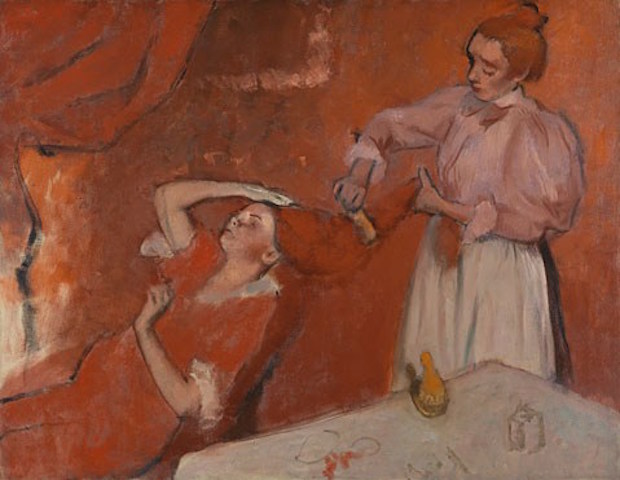
    Degas is often described as a ‘reclusive’ person, inclined to aloofness. Though he associated with other artists and was affected by them, it was hard to maintain a friendship with him. Renoir said: “What a creature he was, that Degas! All his friends had to leave him; I was the last to go, but even I couldn’t stay till the end.” A rigid conservative, an avowed anti-Semite, the Dreyfus Affair even further intensified his hatred of Jews. Though utterly remote from the image of an open-minded, tolerant artist, his creative spirit was indeed unique. It reached full fruition in his late years, when he was less inclined to naturalism and more to abstraction. La Coiffure was painted between 1896-1900, and was owned by Matisse.

    When I first saw the painting in the National Gallery I was stunned. The colors are so bright and vivid (though regretfully it is placed is a rather dark room); only rarely does one find such a colorful painting in a museum. Rich orange, red, some burgundy, it is overwhelming. But I also had a feeling that there was some error within the painting – like a coloring book painted without following the instructions. The same orange color was used for the dress of the young women, her hair, the back wall, the drapery, and there is even a stain of orange on her cheek. This choice, of using a similar color for close objects, is puzzling; it stands in contrast with a fundamental artistic convention – the differentiation of objects by color.

    The painting, then, contains both theme and ‘media’, but they are almost unrelated. Thematically, we see a young woman, and an older one – her mother or a maid- combing the long hair of the young one. Strangely, the hair seems almost like an independent being, belonging to neither of them. I would say the painting is about femininity, about who controls the sexuality of the young woman. Degas’ fascination with women combing their hair is well known. But focusing on the colors reveals almost a different painting: everything is orange besides the older woman, the face of the young woman – and the table. The young woman’s hair blurs almost completely into the blazing orange background. From this perspective, the painting is only about the older woman. Was Degas suggesting a social message here? Perhaps about the place of servants? There is no definite answer to these questions.

    The heart of this painting is its double nature. Degas differentiates almost explicitly between images and colors, between two aspects of the painting that are normally fully integrated: the huge bold orange color on the one hand, and the delicate, refined feminine hands on the other.

    Degas is often described by art historians as an “objective painter”: he neither identifies with the objects of his painting nor judges them. He aims at a very precise description of reality, yet one that contains anxieties, feelings, perceptions. That could hardly be applied to this painting, which is rather different from his normal reserved style. One would have to deduce that there is an emphasized element of abstraction here. Perhaps it is not about the brushing of the hair, La Coiffure, but about the process of materializing an idea in shapes and color, about painting itself.

  • Is Religion Reversible?

    Is Religion Reversible?

    Mircea Eliade (1907-1986) is the most prominent twentieth-century scholar of comparative religion. Human existence, he argues, has two separate realms: the sacred and the profane. Each has its unique nature and characteristics, and also a different understanding of time. Profane time is a chronological development from past to present, and then to the future. Religious time is something else: when taking part in a religious ceremony, it is possible to experience divinity with the same emotional intensity as when that religion was created. Thus, the boundaries of ordinary time are exceeded, and men connect with God as they did in Illud tempus, ‘times of origins’, when religions were created. For example, a Christian participating in the mass may feel the presence of Christ just as his followers in the first century did. He may believe his miracles can be extended to him personally. If he is sick, Christ can heal him. Thus, within the religious experience, it is possible, even if only to some extent, to go back in time.

    In spite of Eliade’s unique contribution to religious studies, he was not the first to contemplate on this aspect of religion. Fyodor Dostoevsky published his masterpiece The Brothers Karamazov in 1880. One chapter, The Grand Inquisitor, can be read separately from the novel. It is a short tale – some call it a parable – describing a most unusual event: Christ comes back to earth for a short visit, at the time of the Spanish Inquisition. Appearing in Seville, he performs several miracles – healing the sick, reviving a dead young girl. People immediately recognize him; they are completely taken by his goodness. But as they follow and adore him, in comes the much-feared Grand Inquisitor, after executing some heretics. He arrests Jesus and sentences him to be burnt the next day. His fault, says the Inquisitor, is that his short visit to earth only interferes with the Church’s mission; he is no longer needed here.

    This brilliant and complex short story can be interpreted is many ways; one reading focuses on the question of religion and time. If the events that formed the birth of Christianity were repeated centuries later, would they carry the same religious significance? Or, to put it more generally, are monotheistic religions a changing spiritual phenomenon, created and then gradually transformed over time, or do they maintain a fundamental unchanged belief? Dostoevsky, as always, provides a complex and intriguing answer.

    When it comes to a personal encounter with the divine, this short masterpiece suggests that people today would be drawn to believe in Christ and follow him exactly as they did in the first century: “”He comes silently and unannounced; yet all—how strange—yea, all recognize Him, at once! The population rushes towards Him as if propelled by some irresistible force; it surrounds, throngs, and presses around, it follows Him…. He extends His hands over their heads, blesses them, and from mere contact with Him, aye, even with His garments, a healing power goes forth.” Christ would probably evoke the same spiritual enthusiasm as he did two thousand years ago.

    However monotheistic religions are also institutions; congregations, leaders who often have extensive political power, common practices, taxes and wealth, and perhaps more than anything, the transformation of primal religious events into a comprehensive way of life. Here, argues the Inquisitor, time cannot be turned back. Religion as a way of life evolved over time, creating different set of customs and rules, sometimes utterly remote from those prevailing in the ‘times of origin’.

    In fact, the Inquisitor’s argument is even more radical: Jesus liberated man by inspiring the hope of happiness generated by free will, of preferring good to evil. Yet true human happiness is the very opposite, a result of lack of choice: “We will prove to them their own weakness and make them humble again, whilst with Thee they have learnt but pride, for Thou hast made more of them than they ever were worth. We will give them that quiet, humble happiness which alone benefits such weak, foolish creatures as they are, and having once had proved to them their weakness, they will become timid and obedient, and gather around us as chickens around their hen.” Clearly, with this skeptical view, the Inquisitor sees Christ as an intruder; he set in motion a historical process that the Church attempts to correct. He created expectations that could never be met, leading to nothing but disappointment.

    So how does the story end? Is Christ executed again? Of course not, that would be a revival of ‘time of origin’; the Inquisitor wouldn’t want that. Christ remains silent all through the story. “The old man longs to hear His voice, to hear Him reply; better words of bitterness and scorn than His silence. Suddenly He rises; slowly and silently approaching the Inquisitor, He bends towards him and softly kisses the bloodless, four-score and-ten-year-old lips. That is all the answer. The Grand Inquisitor shudders. There is a convulsive twitch at the corner of his mouth. He goes to the door, opens it, and addressing Him, ‘Go,’ he says, ‘go, and return no more… do not come again… never, never!’ and—lets Him out into the dark night. The prisoner vanishes.”

    ‘And the old man?’

    ‘The kiss burns his heart, but the old man remains firm in his own ideas and unbelief.’”

  • The Six-Day War – East and West

    The Six-Day War – East and West

    One cannot over-estimate the implications of the Six-Day War, which swept the Middle East in 1967. It completely changed the political shape of the area, creating new circumstances and new difficulties in the Arab-Israeli conflict. A less-known aspect of the war is its effect on Israeli society. As is often the case with wars, it brought to the surface frustration and anger that otherwise perhaps would have remained dormant: the feeling of Sephardi Israelis (people whose families came from Middle Eastern countries) that they were discriminated against by the Ashkenazi elite (the Ashkenazi Jews being those who were descendants of European Jewry).

    Eli Amir (1937– ) is an insightful Iraqi-born Israeli writer. At the age of thirteen he emigrated with his family from Bagdad to Israel. He experienced the difficulties of Sephardic Jews coming to Israel in the fifties: due to lack of accommodation and funds, the huge influx of immigrants were placed in refugee absorption camps; he went to school in a kibbutz, where he encountered a condescending Ashkenazi elite; he then moved to Jerusalem, slowly advancing as a civil servant, struggling with prejudice against immigrants from the Middle Eastern countries. In 1983 he published his first novel, which was followed by several others.

    Yasmine, published in 2005, is a love story between a young Israeli man and a beautiful Palestinian woman. Nuri, the protagonist, a character with a strong autobiographical quality, is a soldier fighting in the Six-Day War on the Egyptian front. Like the author, he emigrated from Iraq as a child, went to school in a kibbutz, left for Jerusalem, and is part of the Israeli forces in the war. Being a fluent speaker of Arabic and well-educated, in the wake of the war he is appointed to a government post in East Jerusalem, where he meets Yasmine. She left her parents to study in the Sorbonne, but concern for them prompted her to visit them. The passionate love story between the two eventually ends in her returning to Paris, feeling that marriage between a Palestinian and Israeli is practically impossible.

    The entire novel revolves around Nuri’s self-perception in terms of East and West. The turmoil generated by belonging to two different cultures drives him to constant contemplation of the nature of each one, and how he is part of it: “I am a Jew born in Arabia, who holds dear the treasures of the West. In the morning I listen to classical music, in the evening to Arab music. A bird traveling between two worlds”.

    But Nuri is not simply wavering between two worlds; he feels the contempt many Ashkenazi Israelis have for Middle Eastern culture. This deepens his solidarity not only with Sephardic immigrants but also with Middle Eastern culture in general: “I am at odds with myself, and with those who are believed to be my brothers. Sometime very close to them, sometimes horrified by them. I miss the Tigris River, the palm trees, my home in Bagdad, but I will never return there”.

    So, strangely, this young man who fought against the Egyptian army in the Six-Day War finds himself feeling more at ease with Arab culture than with the values and lifestyle of many Israelis. He even defends the Egyptian soldiers, ridiculed by Israelis for fleeing without fighting.This inevitably brings to the surface the Sephardi-Ashkenazi conflict, in a way that leaves no room for any ambiguity or avoidance.

    Amir further elaborates on the role of the Six-Day War in the worsening of ethnic tensions in Israel. In the frame of his post in the Israeli government, Nuri meets several cabinet ministers, and also Levi Eshkol, the prime minister at the time. To his utmost surprise they converse in Yiddish (the language of Ashkenazi Jews); affectionately they call him yunger-man, young man. But not only that: he then realizes that the Ashkenazi elite perceives the victory of Israel in the war in terms of West vs. East. The prime minister, his cabinet, and in fact most Ashkenazi Israelis, believe that Israel won because it is a western country; to put it more precisely, they think that the Arab nations lost due to their backward Middle Eastern mentality. This leads Nuri to an almost impossible emotional dilemma, not knowing where he belongs.

    All this does not lead Amir to a simplistic preference for the Middle Eastern mentality – in fact, is it the other way around. Nuri says: “I love the east, the role of the family, the manners, the warmth, the colors, the odors, the crowd, the sweat, but I also detest it for its stench, hypocrisy, treachery, its blind and cruel fanaticism, and I prefer the open-mindedness of the West, its airy alienation and distance”.

    The novel follows the emotional dilemma that led to the outbreak of protests by Sephardic Israelis. In 1971 the ‘Black Panthers’ violently challenged the Israeli establishment for its discrimination against Sephardic people. And though the intensity of these feeling has diminished greatly today, the issue of Ashkenazi-Sephardi relations is still very relevant; it is certainly part of party agendas in the coming elections.

  • Alvin Ailey’s Imaginary Scenery

    Revelations, a dance by the American choreographer Alvin Ailey, is believed to be the most viewed dance performance of our time. People from all around the world enjoy this moving and lively work. Enchanted by the expressive movements, carried away with the music, they are drawn into the world of African-Americans and their journey from slavery to freedom. By the end of the show the audience is extremely excited – much more than in most dance productions. Is this simply the result of an excellent performance?

    Alvin Ailey (1931-1989) was born in Texas to a seventeen-year-old mother; his father deserted them when he was six months old. Poverty, racial segregation, and moving from place to place filled his childhood experience. At the age of eleven his mother moved to Los Angeles and he joined her shortly afterwards. Los Angeles offered better education, and young Alvin revealed an inclination to the languages and arts. After some hesitation he decided to turn to dancing. He joined the Horton School for Dancing, a school with a very particular perspective: all students had to take not only ballet and modern dance classes, but also painting, acting, design, music, and costuming. Alvin absorbed this approach and later made it an important element in his work. In 1958 he founded the ‘Alvin Ailey American Dance Theater’, a dance group combining various dance styles: ballet, modern dance, jazz – and African dance. Revelations, his masterpiece, is founded on his bitter memories from Texas, and more generally, it presents the history of African-Americans, from slavery to freedom.

    When creating Revelations, Alvin strived to reach a holistic theatrical experience. The costumes, the lighting, even the make-up were all part of the dance, as important as the choreography and the performance of the dancers. The movements can be described at an abstraction of the daily lives of African-Americans: a humped slave looking down, people looking upwards in prayer, poorly dressed slaves, women using straw hats, hand fans and parasols to cope with the heat, baptism in the river, a ceremony in the church, slaves working in cotton fields. The mimesis of daily life is very detailed, to the point that typical facial expressions are presented.

    One thing, however, is lacking: theatrical scenery.

    At the back of the stage either a huge sun or a moon can be seen. Nothing more. No picture of life in the south of the United States at the time, nothing constructed on stage to create an illusion of real life in the South — all that is left to the imagination of the audience. Every spectator watching this magnificent work has to use his or her imaginative faculties to reconstruct the circumstances depicted in the dance.

    Of course, lack of theatrical scenery is nothing uncommon in modern dance. The break with the rigid tradition of classical ballet also entailed reservations regarding the pseudo-realistic scenery of well-known ballet performances. Today, digital art is often part of a dance. But all these are entirely different from the daring experimental spirit of Alvin Ailey: presenting history through dance, without scenery to support it.

    The use of accessories – dancers holding parasols, swinging hand fans in different directions, even waving a blue silk cloth on stage to represent ‘the river’ – only further emphasizes the absence of a matching background. Accessories are almost never used by themselves; they match, in form and substance, the general conception of the performance. In Revelations, they are clues; objects that are intended to evoke associations of African-American life without explicitly presenting it on stage.

    The fullest expression of the unique role of accessories is the use of stools in ‘The Day is Past and Gone’, in the third part of Revelations. A couple of women dance while sitting, turning, or standing on stools. The realistic notion created by this very simple piece of furniture is strongly juxtaposed with the lack of a wider context: where are they sitting, why did they meet, when did they meet?

    In omitting what would normally be an essential part of the show, Ailey turns the audience members into active participants: a constant effort has to be made – even if unconsciously – to reconstruct the historical environment of the dancers. The spectators are like readers of a book, who know the plot but don’t know where and when it took place. Thus, the sufferings and joys of African-American history are revived in the most personal and meaningful way.

    In the very last song, ‘Rocka my Soul in the Bosom of Abraham’ the audience goes wild. After reliving the suffering of slavery, bringing the old Deep South back to life, they revel in the liberating message of Gospel music – just like the African-Americans portrayed in Revelations.

  • A Song of Misery and Hope

    A Song of Misery and Hope

    The dramatic historical events of World War II are extremely difficult to contain. The plenitude of films, documentaries, photos, and books on the subject often obstructs the desired transformation from pure academic knowledge to empathy with the victims of the atrocities experienced by so many. Yet sometimes a very simple sight or sound can capture the events of the past better than anything. Whenever I think of the Nazis, a childhood memory immediately surfaces: I hear the monotonous sound of Nazi soldiers marching in Le Chant des Partisans, sung by Yves Montand.

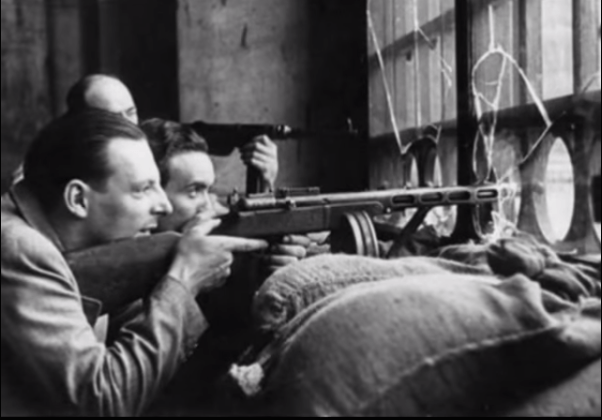
    Le Chant des Partisans was the song of the French Résistance during the Nazi occupation of France, a symbol of the underground forces fighting the German army. Anna Marly, a young dancer and singer who fled from Russia with her mother at a very young age, composed it. A talented and colorful young woman, she was a ballet dancer in Monte Carlo, studied with Prokofiev, and worked in Parisian cabarets. In 1940, after the fall of France, she escaped with her husband from Paris and ended up in London. Her inspiration for the tune of Le Chant des Partisans was an old Russian song she had heard. Anna wrote the lyrics together with Joseph Kessel and Maurice Druon, but later complained that the only suggestion of hers that was accepted was the use of ‘crows’ as a metaphor for Nazi planes. The lyrics and melody were completed in 1943. She sang it beautifully.

    It was first aired on Radio-Londres, the BBC daily broadcast in French to occupied France. Immediately, it became extremely popular. Anna was also a very good whistler, and André Gillois, a radio broadcaster at the BBC, used her whistled version as Radio Londre’s theme tune. French Resistance members appeared on this show, encouraging their fellow countrymen to actively resist the Nazi occupation. These broadcasts were also used to convey coded messages to Résistance groups in France. The Nazis prohibited listening to it and attempted to jam the transmission. Yet many Frenchmen waited every day for Anna’s clear whistling of Le Chant des Resistance.

    The song became a hymn in anti-Nazi France. Singing it was an act of rebellion. Since their national anthem, The Marseillaise, was banned by the Nazis, Frenchmen used Le Chant des Partisans as a substitute. In fact, it became customary to sing it every time a Résistance fighter was killed. Many years after the war, whenever Anna performed it in France, people would come to her with tragic and heroic tales, remembering what it had represented for them. Once, a former fighter revealed a horrible story: he and four others had been captured by the Germans and ordered to dig their own graves. As they dug, “to give us spirit we were whispering your song”. They were shot, and he was the only one to survive.

    Even after the war the song did not lose its significance. It was even proposed as a new national anthem for France. Anna had written other songs about the partisans. One of them, written with the Résistance leader Emmanuel d’Astier de la Vigerie, was called “La Complainte du Partisan”. It was translated into English and performed by many artists, among them Leonard Cohen and Joan Baez.

    I came across this recording of this song as a child, in Jerusalem. My parents, like most people whose lives had been shattered by World War II, refrained as much as possible from describing the arocities of the war. It was my cousin, the late Claude Gandelman, who brought us the record. Claude was born in France and was a child during the war. He was hidden in the centre of France, where his father, a physician, was active in the Résistance. He later immigrated to Israel and was a professor of French Literature in Haifa University. He gave us a box full of old records, and thus I was introduced to the best performers of French music.

    But this song was different. I listened to it over and over again, though I didn’t speak any French. The sound of the Nazi soldiers marching was chilling; the Nazi screams were horrifying. But then I realized that some whistles could be heard alongside the clicks of the soldiers’ boots. When I asked Claude, he explained that preceding a Résistance action, its members would communicate with each other via very low, almost inaudible whistles. I listened to the song many times but since he told me this, I began to hear a different tune – more bearable, less threatening.

    The partisans’ song – English Translation

    Mate, do you hear the dark flight of the crows over our plains?
    Mate, do you hear the muffled clamour of enchained countries?
    Hey, partisans, workers and peasants this is the signal
    tonight the enemy will know the price of blood and tears…

    Join the sabotage, get off the hills, comrades!
    Take the rifles, the machine gun, the grenades out of the straws.
    Hey, killers, with a bullet or by knife, kill swiftly!
    Hey, saboteur, take care of your charge: dynamite…

    It’s us smashing the prison bars for our brothers,
    The hatred on our backs and the hunger that drives us, the misery.
    There are countries where people are dreaming deep in their beds,
    here, we, you see, we’re marching on and we’re getting killed, we’re getting whacked…
    Yes, we’re getting whacked…

    Here everyone knows what he wants, what he does when it takes place,
    Mate, if you go down, a mate out of the shadows takes your place.
    Tomorrow black blood will be drying under the sun on the roads,
    sing, colleagues, freedom is listening to us in the night…

    Sing…
    Come on, sing…
    Sing, colleagues!

  • A Goddess Descending

    A Goddess Descending

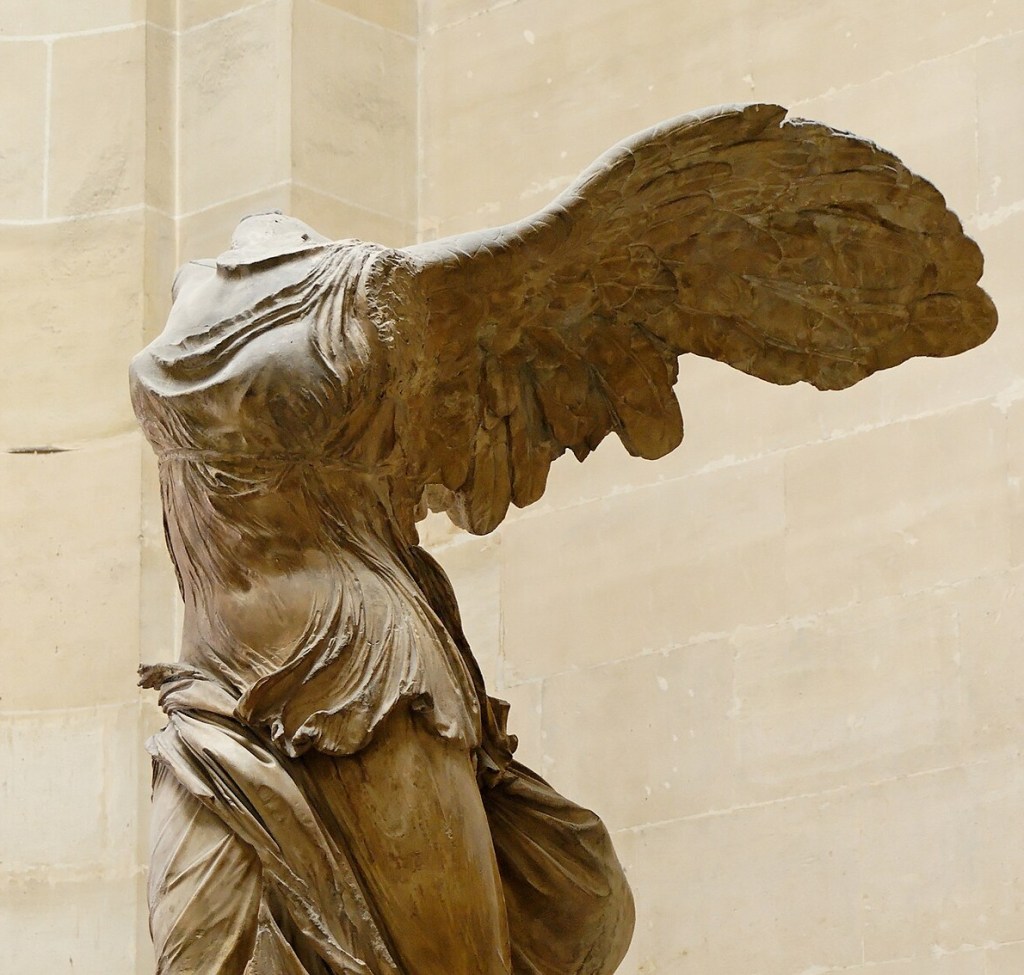
    One of the most valued works of art of the Louvre Museum is a gigantic headless statue – almost two and half meters long – of a female figure, with huge wide-spread wings. The figure’s drapery seems animated, suggesting that she is in motion, and the body itself reveals a strenuous movement. The intensity of the figure is overwhelming: she is strong, vibrant, dynamic.

    Nike of Samothrace, also called ‘Winged Victory of Samothrace’, is a marble sculpture of Nike, the Greek goddess of victory. It was discovered in 1863 in Samothrace, an island in the North Aegean Sea, by Charles Champoiseau, a French diplomat and an amateur archeologist. It was headless and armless; one arm was found later, in 1948. The statue is believed to have been created in the early second century BC. Modern excavations suggest that it occupied a niche above a theater, standing on a grey marble structure representing the prow of a ship. The goddess has just descended onto the prow; her wings are still pulled back by the wind. The entire composition most likely commemorated the battle between Rhodes and Antiochus III in the second century BC.

    The sculpture has been on prominent display in the Louvre since 1884. In spite of its immense size it was removed for protection from the museum before the outbreak of World War II. In September 1939 a special wooden ramp was constructed in the Louvre in order to carry this gigantic piece of art to a safer place. During the war it was kept in the Chateau de Valencay, together with Michelangelo’s Slaves and other masterpieces.

    Surprisingly, the Nike sculpture is extremely expressive in spite of it being headless. Though created with a face and body, arms and wings, the body – in itself – is astounding. We tend to think of outstanding images in traditional art as having both face and body. Portraits can also be uniquely moving – but one can hardly find such a passionate image of a headless body. One wonders, what is it about Nike of Samothrace that makes people gather around her, mesmerized, reluctant to walk away?

    The secret of her charm may be not what we see as we look at her, as captivating as she is, but mostly what we do not see: the strong sea breeze Nike is struggling with.

    H. W. Janson, a noted art historian, observes a fundamental difference between Nike of Samothrace and all other Hellenistic sculptures: her surroundings are a part of the sculpture itself. The invisible gust that she is facing is a segment of the statue just as much as is the goddess’s body, or her huge wings.

    Greek and Roman statues are self-contained. Men or women, well balanced and harmonious, every sculpture is a complete entity, regardless of its positioning. Even if several sculptures together form a mythological scene, each can also be viewed as “detached from the background.”

    But Nike of Samothrace is different, argues Janson: “The goddess has just descended upon the prow of the ship; her great wings spread wide, she is still partly air-borne by the powerful head wind against which she advances. This invisible force of on-rushing air here becomes a tangible reality; it not only balances the forward movement of the figure but also shapes every fold of the wonderfully animated drapery. As a result, there is an active relationship—indeed, and interdependence—between the statue and the space that envelops it, such as we have never seen before. Nor shall we see it again for a long time to come. The Nike of Samothrace deserves her fame as the greatest masterpiece of the Hellenistic age.”

    Looking at the Nike of Samothrace, I feel profound awe: the genius of the artist, who instilled such intense movement in this huge rock, seems to me unmatched, even in later periods. The motion – abrupt yet frozen – is stunning: Nike is utterly confident, in spite of her manifested effort to overcome the facing wind; she will descend onto the prow of the ship and declare victory, no matter how strong the drafts are. And I can’t help contemplating what her face looked like: was she serene? Smiling lightly? Did her face betray the struggle with the wind, or was she indifferent to anything besides triumph itself?