Category: Uncategorized

  • A feminine Christ – A.B. Yehoshua

    A feminine Christ – A.B. Yehoshua

    In the decades since the formation of the State of Israel, a slow and gradual change has been taking place in the attitude of Israelis towards Christianity. When the country was founded, the memory of being a persecuted minority in a Christian world was vivid in the minds of many; large numbers of new immigrants bore the trauma of the Holocaust. Thus, Christianity was seen mainly as an anti-Semitic phenomenon, and teaching it never became part of high school curriculum. Today the Christian world evokes some antagonism perhaps – but mainly increased curiosity.

    A.B. Yehoshua (1936-2022 ), a well-known Israeli author, exemplifies this change. Born in Jerusalem to a Sephardic Jewish family that has lived in the city for five generations, he served as a paratrooper in the IDF, studied philosophy at the Hebrew University, and later became a literature professor at Haifa University.

    In 2004 he published a novel titled A Woman in Jerusalem. During the second Intifada a terrorist explodes himself in the central Jerusalem food market. An anonymous woman is brought unconscious to the hospital on Mt. Scopus and dies after a couple of days. Her body lies nameless in the hospital morgue. Strangely the body is intact, except for wounds in her palms and feet and a scratch on her forehead. A local reporter learns that she used to work at a big bakery in Jerusalem. The owner, publicly criticized for not taking care of a wounded employee, is unable to find any record of her employment. He orders the human resources manager to find out who she was, and when the bakery had employed her.

    The reader becomes part of the human resources manager’s efforts to reveal her life circumstances. Yulia Ragayev, a woman about forty years old, came from the Former Soviet Union to live in Jerusalem. Her partner and a son left Israel as the threat of terror grew, yet she was determined to stay.

    Yulia was an illuminated person, charismatic in an introverted manner. Not exactly beautiful, not very sociable, yet there was something about her that made everyone love her. The night-shift manager at the bakery was touched by this foreign worker; thinking that a delicate woman like her shouldn’t be working at cleaning, he sent her off to find another job, without letting anyone know. She lived in a shack in an ultra-religious part of Jerusalem, and was loved by the people there “even though she wasn’t Jewish”. The doctors at the hospital were attached to her, in spite of her being unconscious. And the human resources manager became captivated by her image after her death, feeling she might emerge any minute now, alive and well. Her unique nature is emphasized by the fact that she is the only character who has a name.

    The owner of the bakery, feeling guilty for not visiting her at the hospital, decides to have her buried at home, in her village in Eastern Europe. So begins a long, hard journey. The human resources manager, the reporter, her son, her ex-partner, and other people, all join in accompanying Yulia on her way to her burial.

    After overcoming endless obstacles, they finally reach the remote village in the high mountains. Her mother returns from a short stay at a convent, wearing a nun’s robe. Learning that her daughter was brought to be buried there, “the old woman reacted like a wounded animal […] she threw herself at the human resource manager’s feet, pleading that her daughter be returned to the city that had taken her life. That way, she, too, the victim’s mother, would have a right to it”. The human resources manager, now fully absorbed by the character of Yulia, accepts the mother’s wish to take the body back to Jerusalem.

    A.B. Yehoshua’s way of familiarizing the reader with the Gospels is by dismantling the passion of Christ, and then embedding various elements in present-day Israel. The illuminated character, here a woman rather than a man; the wounds, which resemble those of the crucifixion; the days the body lies not in a cave but in the morgue; the journey of the disciples; a via dolorosa; Yulia’s preferring her religious belief over being with her family; the route to Jerusalem; the sensitivity to society’s weaker members  – all reflect Jesus’s life and death, yet A. B. Yehoshua has planted them in a new, modern story. In doing so, by no means is he voiding them of their spiritual meaning; on the contrary, they become more tangible, easily appreciated by the Israeli reader. The story of Yulia Ragayev’s life and death is about piety, grace, and generosity; it has nothing which provokes antagonism.

    And there is Jerusalem. In the midst of the bloody Arab-Israeli conflict and the struggle between Jews and Muslims over the city, A. B. Yehoshua reminds us that millions of Christians see it as their own – not in a political sense, but in a fundamental spiritual way. Whoever rules the city, should always keep this in mind.

  • Stalin and the Devil – The Master and Margarita

    Stalin and the Devil – The Master and Margarita

    Much has been written about Joseph Stalin – his ruthlessness, his inability to trust anyone, his brutality, and, of course, the millions of people he imprisoned, exiled and executed. A huge body of research is devoted to his personality and his implementation of socialist ideas. Yet one particular literary work, insightful and original, provides a unique historical observation of his regime, one that is lacking in most history books.

    Michail Bulgakov wrote The Master and Margarita between 1928 and 1940. These were hard years. Stalin’s regime became more oppressive, citizens of the Soviet Union were gradually being deprived of their personal rights; any expression of criticism implied immediate exile, if not a death sentence.

    Bulgakov, born in 1891 in Kiev, was a medical doctor and a surgeon who later became a writer. Having grown up in a family that encouraged humanistic education, he had always been fascinated by literature, music, the theater. While serving as a doctor in the Ukraine People’s Army he was infected by typhus. Following this experience he abandoned the medical profession and decided to devote all his time to writing. His best-known work is the imaginative and fantastic novel The Master and Margarita.

    This masterpiece depicts a most unusual event: during Stalin’s regime, the devil comes to visit Moscow. He is called ‘Professor Woland’; he is a polyglot and a translator, a mysterious character who insists that God exists and that the crucifixion of Christ did take place. Yet even regardless of his theological arguments he is a fascinating character: colorful, charming, enigmatic. This does not mean he isn’t the embodiment of ultimate evil – he can be as cruel and brutal as one could imagine. But he is certainly never dull or boring.

    He is accompanied by three male assistants and a female one. There is the ridiculous-looking Koroviev, who can see through a man’s mind. Never violent, he sticks a needle into a man’s heart, a figurative image of his unique ability to observe hidden feelings and thoughts. Behemoth, a huge black cat walking on two legs, can charm anyone to death. Azazelo, the crudest of the three, a monster-like creature with a fang jutting out of his mouth, can perform any task impartially. The fourth member of this group is Hella, a witch-like woman, who is the devil’s junior assistant.

    This diabolical bunch travels around Moscow, ridiculing various aspects of the communist regime: the literary club (what would have happened had Dostoevsky tried to enter the club? He would have been kicked out, since he didn’t have a party membership card); the common values communism is attempting to instill (in a magic show the crowd leaps to grab dollar bills falling from the ceiling); the teaching of atheism, and above all, the lack of personal freedom. The artist, Margarita’s love, is committed to a psychiatric clinic and is prevented from publishing his literary work. Margarita, a character inspired by Bulgakov’s third wife and his true love, accepts the devil’s offer to be the hostess at the ball of the dead, in return for which she asks for the release of her beloved artist.

    The heart of Bulgakov’s criticism of the communist regime is not the specific arguments he makes. It is his juxtaposing of Stalin with the devil, the symbol of ultimate evil, as it evolved throughout the generations. Assuming that evil will always be part of human existence, the question of which is worse – Stalin or the devil – comes up naturally, almost unwittingly. Would we prefer the devil’s doings – arbitrary and painful, but intriguing and diversified, or Stalin’s ambition – a unified, standardized system, aimed at blurring the differences between men, creating a dull and lifeless society? By the end of the novel, the answer is self-evident.

    The Soviet regime prevented the publication of the book. Its criticism of the implementation of communist ideas was clear, though party officials may not have grasped just how profound it was. Yet Stalin himself thought very highly of Bulgakov. He cherished his artistic work and saw to it that he would not suffer physically harm.

    Bulgakov was not permitted to publish the novel, and his constant requests to be allowed to leave the Soviet Union were refused. In his desperation he wrote two personal letters to Stalin. His wife was horrified, saying this was tantamount to attempting suicide; people were sentenced to death for much lesser things. However, he wasn’t harmed in any way as a result of these letters.

    Bulgakov worked almost until his death, dictating the last sentences of the novel to his wife. A couple of hours after his death the telephone rang in his apartment – someone from Stalin’s office wants to know if the great artist Mikhail Bulgakov had passed away. When she said ‘yes’ the line went dead.

  • Else Lasker-Schüler – an Alienated Poet

    Else Lasker-Schüler – an Alienated Poet

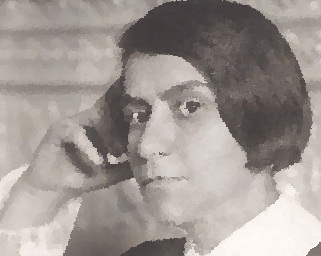
    The life story of Else Lasker-Schüler is the story of German Jewry from the late nineteenth century until World War II: Jews who were neither part of the traditional Jewish way of living, prevailing in Eastern Europe, nor fully assimilated into the non-Jewish German society. But it is also the fascinating and tragic biography of a uniquely original and talented poet, highly praised in Germany both during her lifetime and after her death.

    Else was born in 1869 in Elberfeld, Germany to an assimilated Jewish family. As a child she knew she was Jewish, but was unaware of Jewish tradition. On Yom Kippur her parents would invite friends and have a huge meal, and young Else would wonder what it was that they were celebrating. Due to an illness she left school at the age of eleven, and acquired her education from her mother, herself a poet. At the age of thirteen her beloved brother died; eight years later her mother passed away. Else was a very unusual young woman – soemwhat depressive, creative, imaginative, eccentric.

    She married and divorced twice, and had a son whose father was unknown, an extremely uncommon occurrence at the time. In the first two decades of the twentieth century she was a key figure in Berlin’s bohemian circles; her poems were highly appreciated. Extravagantly dressed, ignoring social conventions, she wandered around Berlin’s coffee shops with her son, adored by artists and intellectuals, a leading female character in German expressionism. In 1932 she won the prestigious Kleist Prize. Yet the poems she wrote at this time reveal a sense of alienation; a feeling of never being part of a social circle, always alone, immersed in an inner spiritual world. She didn’t feel part of German society, yet she was utterly detached from Jewish life.

    Growing anti-Semitism made Else delve into Judaism. Since she lacked any knowledge of beliefs and customs, she began reading the Bible. The biblical figures became vivid in her mind as though they were her contemporaries, and the depictions of the ‘Heavenly Jerusalem’ were as real to her as a place which one could actually visit. Her poems and drawings portray the stories of the Bible in a penetrating and imaginative way. A well-known collection, Hebrew Poems, describes the characters of David, Saul, and Deborah the prophetess.

    In 1927 her son Paul died of tuberculosis. Broken-hearted, her poems from that period were consumed with agony and death. In 1933, at the age of sixty-four, she was beaten in the street by a group of Nazi thugs. As she returned home she decided, in her impulsive way, to leave Germany immediately. She didn’t tell any of her friends that she was leaving and as a result she was declared a ‘missing person’ until she was found safe in Switzerland.

    Else made three journeys to Palestine. The first two left a deep impression and inspired some wonderful poems and drawings. In 1939, at the age of seventy, she traveled for the third time to Jerusalem, but with the outbreak of World War II, the Swiss authorities prohibited her return to Switzerland.

    She spent the last six years of her life in Jerusalem, suffering poverty, illness, and above all, solitude. She was often seen feeding street cats and birds while talking to them; a bizarre – not to say deranged – woman, ignoring everything besides the animals and a few German friends. Yehuda Amichai, an Israeli poet, remembers the children of Jerusalem mocking her. And Leah Goldberg, also a poet and a scholar, recalls watching her: “The café was almost empty. She sat in her usual place, gray as a bat, small, poor, withdrawn … this dreadful poverty, the terrible loneliness of the great poet.”

    The encounter between the real Jerusalem and the imaginary one was very painful for Else, though not all destructive. At the time the city combined a universal spirit with the state of mind of a small town. The tensions between Arabs and Jews, the poverty of some quarters, the pilgrims of all religions, the many religious and cultural symbols so many cherish – they all were details in her spiritual path. She was devastated by the news coming from Germany, worried about her friends, but fully aware that there was nowhere for her to return to after the Holocaust. She drew many pictures of Jerusalem, and completed her last collection of poems, My Blue Piano.

    In 1945 Else died at home, alone. She was buried in the cemetery on Mt. Olives. Very few people attended her funeral.

    My Blue Piano/ Else Lasker-Schüler, 1943

    At home I have a blue piano.

    But I can’t play a note.

    It’s been in the shadow of the cellar door

    Ever since the world went rotten.

    Four starry hands play harmonies.

    The Woman in the Moon sang in her boat.

    Now only rats dance to the clanks.

    The keyboard is in bits.

    I weep for what is blue. Is dead.

    Sweet angels, I have eaten

    Such bitter bread. Push open

    The door of heaven. For me, for now —

    Although I am still alive —

    Although it is not allowed.

  • Germany and the Germans

    Germany and the Germans

    On May 29th 1945, three weeks after the surrender of Nazi Germany but before the nuclear bombs were dropped on Hiroshima and Nagasaki, the world-famous German author Thomas Mann (1875-1955), Nobel Prize laureate in Literature, gave a lecture at the Library of Congress, titled “Germany and the Germans”. Many looked forward to this address with anticipation; Thomas Mann was considered a supreme interpreter of German culture throughout the world, and a fierce opponent of Nazism. The emigration of the Mann family from Germany in 1933 had echoed in the international press, contributing to the universal opposition to Nazism.

    Addressing the question of German national character, he began by announcing that “I am to speak to you today on Germany and the Germans—a risky undertaking, not because the topic is so complex, so inexhaustible, but also because of the violent emotions that it encompass today”. Yet, notwithstanding the turmoil created by WWII and the Holocaust, he presents a fascinating and solid explanation for the rise of Nazism in Germany.

    Before delving into a historical analysis, Mann asserts that he sees himself as part of German culture. In spite of being a brave opponent of the Nazis, he argues that there are no ‘good Germans’ or ‘bad Germans’: “Any attempt to arouse sympathy to defend and to excuse Germany, would certainly be an inappropriate undertaking for one of German birth today. To play the part of the judge, to curse and damn his own people in compliant agreement with the incalculable hatred that they have kindled, to commend himself smugly as ‘the good Germany’ in contrast with the wicked, guilty Germany over there with which he has nothing at all in common, — that too would hardly befit one of German origin. For anyone who was born a German does have something in common with German destiny and Germany guilt”.

    He then turns to the historical arguments. Already in the sixteenth century Martin Luther, the founder of the Protestant Reformation, instilled an ambivalent attitude towards freedom: “And no one can deny that Luther was a tremendously great man, great in the most German manner, great and German even in his duality as the liberating and the once reactionary force, a conservative revolutionary. He not only reconstituted the Church; he actually saved Christianity”. From the individual’s perspective, Luther was a great liberator: he encouraged a direct encounter between man and God, freeing him from the power of the priesthood. He translated the Bible so every believer could read it himself. Yet from the perspective of society as a whole, he supported the darkest forces oppressing the evolvement of a free society. He was a liberator of the inner experience, but fiercely rejected the idea of political liberty. Germans were encouraged to nurture their feelings, artistic drives, religious beliefs – yet political freedom was denounced.

    This dualism, argues Mann, was further expanded by Goethe, the great German poet, in the eighteenth and nineteenth centuries. In his play Faust, a masterpiece, the protagonist, Faust, makes a pact with the devil in order to achieve full self- gratification. Though the explicit point of view of the author is a condemnation of this pact, the play leaves plenty of room for moral ambivalence. The reader can infer that in order to fulfill one’s desires it would be imperative to have a pact with the devil. And Mephisto, who satisfies Faust’s wishes, is far from being repulsive. He is smart cunning and strong: “And the devil, Luther’s devil, Faust’s devil, strikes me as a very German figure, and the pact with him, the Satanic covenant, to win the treasures and power on earth for a time at the cost of the soul’s salvation, strikes me as something exceedingly typical of German Nature. A lonely thinker and searcher, a theologian and philosopher in his cell who, in this desire for world enjoyment and world domination, barters his soul to the Devil, — isn’t this the right moment to see Germany in this picture, the moment in which Germany is literally being carried off by the Devil?” Indeed, during WWI, Goethe’s Faust was distributed to the German soldiers before they were sent off to battle.

    If Luther’s theology created a sense of a boundless self, utter liberation of instincts, emotions, thoughts — yet without any political progress towards democracy – Goethe implanted the notion of moral ambivalence, suggesting that in order to achieve one’s goals one would have to succumb to the enchantment of the devil.

    These two influences led to the evolvement of Nazism. The State of Germany was not the result of a yearning for democracy: “Fundamentally Bismarck’s empire had nothing in common with “nation” in the democratic sense of the word. It was purely a power structure aiming toward the hegemony of Europe, and notwithstanding its modernity”. Boundless individual self-fulfilment was encouraged; the widespread moral stand was ambivalent, suggesting that cruel brutality is a necessary evil – and the result was Nazism; a full realization of a historical process that commenced in the sixteenth century.

    Well worth reading; a brilliant historical analysis.

  • Is Arnolfini Blind?

    Is Arnolfini Blind?

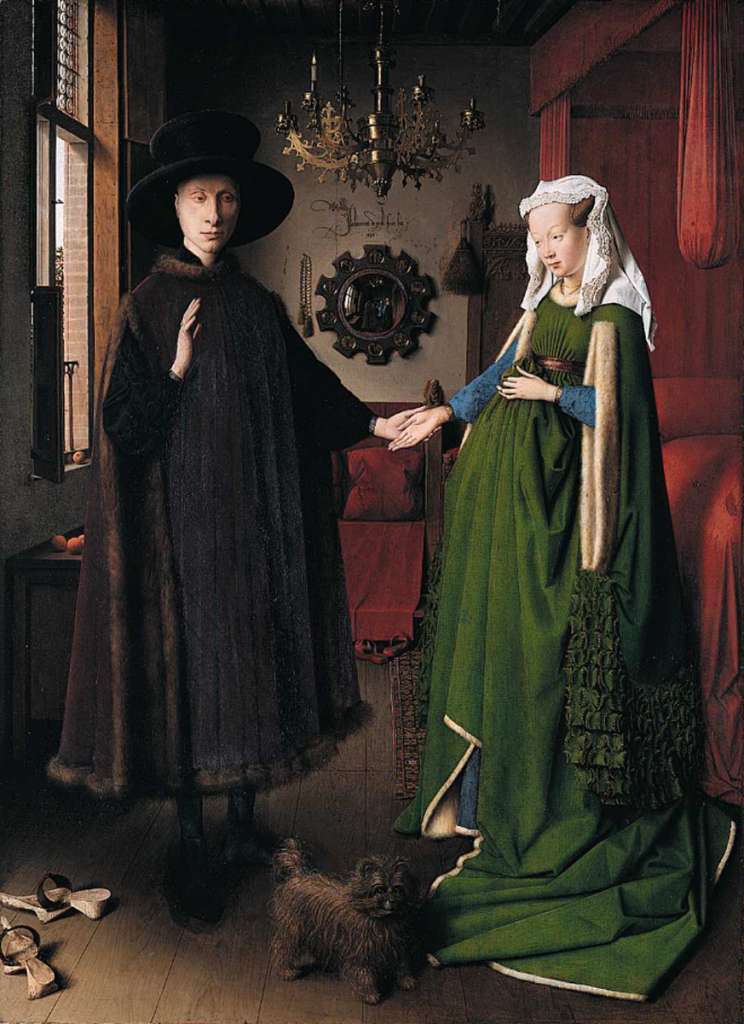
    There are some enigmas that never cease to challenge the world of art history. One of them is a small picture, a masterpiece by Van Eyck dated 1434, often referred to as ‘The Arnolfini Portrait’.  It is generally believed that the man in the picture in a member of the Arnolfini family, wealthy Italian traders who lived in the Flemish city of Bruges.

    Looking at the picture, one cannot understand what the man and the woman are doing; he is raising his hand in a ceremonial manner, they stretch a hand towards each other, not quite holding hands. In addition to the man and the woman, two people are reflected in mirror behind them, and there is a strange huge autograph of the painter: Jan Van Eyck was here.

    Several art historians tried to find a plausible explanation for this portrait. The masterful scholar Ervin Panofsky had published an article at the Burlington Magazine in 1934 arguing the picture is a legal document denoting Arnolfini’s wedding: the position of his left hand is that of taking a wife, and the position of right hand symbolized the act of marriage. The two people in the back are the witnesses; perhaps one is the artist, who therefore signed the picture with huge letters. Other art historians disagree, providing various possible explanations: it is a betrothal, not a marriage; the woman only appears pregnant, but it was a fashionable dress at the time; Arnolfini is granting his wife legal rights; it is another member of the Arnolfini family, since this lady died before the painting was created; this may be a painting in memory of Arnolfini’s wife; this is an unknown wife of one of the Arnolfini brothers; we cannot be sure it is a member of the Arnolfini family. And there are scholars who believe the iconography of the painting has no particular meaning, it is simply a woman and man in an unusual position.

    I saw photos of The Arnolfini Portrait several times; but as I was facing the painting itself, as if often the case, new emotions and observations were created. I had a strong notion that there is a fundamental difference between the countenance of the man and the woman. After many deliberations I came to the conclusion that Arnolfini, the man, isn’t looking anywhere, whereas his wife’s look is rather focused. If I was examining the painting without knowing the various interpretations I would say Arnolfini was blind.

    Following this hypothesis would lead to an altogether different interpretation of this masterpiece: it is a subtle yet apparent description of blindness. Arnolfini is stretching his right hand to his wife without being able to see her hand. Therefore they don’t hold hand as would be expected, but their hands are touching in an unusual way. This is Van Eyck’s artful manner of demonstrating that Arnolfini can’t see her hand.

    The mirror in the back exhibits two people present in the room, yet they cannot be seen directly. Is it possible that Arnolfini himself is unaware of their presence?! Perhaps it is simply a way of directing the spectators’ attention to the question of who can see whom.

    Since it is daytime, the one candle lighten in the chandelier is clearly unnecessary, unless it is symbolic of vision that is lacking. Even Van Eyck’s huge signature, with the strange inscription – that he was there – may reveal a need one feels when standing next to a blind person: to speak louder, to touch him or her, to make noise whilst moving around the room, or, in short, to make one’s presence more noticeable.

    It is true that the painting doesn’t follow the accepted gestures denoting blindness in art: head leaning backward, closed eyes, eyes lacking pupils or irises, using a walking stick. But all these are typical of an earlier time, and even then, there are examples in which blindness can be detected only by a person’s facial expression.

    My father, Moshe Barasch, an art historian, had written a book on blindness in art, titled Blindness. On its place in fifteen and sixteen centuries he says, “Blindness is not a central theme in Renaissance imagery. Neither in literature nor in visual art is much paid to the sightless person… the persons deprived of it are marginal, often nonexistent”. Van Eyck in not depicting a metaphorical blindness or a spiritual one; this could simply be a picture, one could say a modern one, of a wealthy merchant who cannot see

    If, indeed, the man in the picture is blind, what is it that he is doing? If I had to guess, I would say he is anxious of the approaching childbirth, fearing perhaps that the child will be also an invalid. Could he be taking an oath that if the child would not be blind he would donate sparingly to the city or to the church?  His wife seems anxious too, almost fearful of the future. There are two witnesses to this oath, and a signature of Van Eyck. May God give me a healthy baby, able to see the world.

  • Jesus in Israeli Society

    Jesus in Israeli Society

    Teaching Israeli students about Jesus Christ is a fascinating experience. I am not talking about Christian theology, but about his depiction in the Gospels, as a literary character.

    Generations of Jews saw Christ as an adversary and a foe, the cause of their endless sufferings. Most didn’t even pronounce his name, referring to him as ‘that man’. In the modern age, Zionism has focused completely on the future of the Jewish people. The Christian world, a variety of perspectives and worldviews, was perceived only through Zionist spectacles: as a realm exterior to Jewish life, distorting it by its ruthlessness. Eventually, this shaped the Israeli education system. Even today, most high schools do not teach the foundations of Christianity, which are, of course, imperative for understanding Western civilization.

    But art, as is often the case, heralded a change. From the early twentieth century, several Israeli writers attempted to examine Jesus from a fresh perspective – not as victims of Christianity, but as independent thinkers who are influenced by it. Since the foundation of the State of Israel, the common sentiment of a persecuted minority has been transformed into a notion of potency and stamina; this, in turn, created a new, open-minded attitude to the image of Christ.

    Pinhas Sadeh (1929-1994), an Israeli novelist and poet, was one of the forbearers of this change. Born in Poland, he immigrated to Israel with his family at a young age. A colorful character, some would say even controversial, a poetic soul surrounded by young admirers. At the age of 27 he published Life as a Parable. The book is a collection of personal experiences, each one illustrating a certain theme. Several years after its publication, it became a cult book among young people.

    Though all the events depicted in the book unfold in Israel, it is hardly apparent. They could have taken place anywhere. Sadeh neither accepts Zionism nor rejects it. He exists in a universal human sphere; an artist unchained by any ideology.

    Life as a Parable is profoundly influenced by the image of Jesus and the New Testament: an acknowledgement of human suffering, forgiveness, spiritual love, and the enlightenment of religious life. The author examines his surroundings from a fundamentally Christian perspective.

    In his portrayal of Christ, Sadeh completely ignores the complex historical questions regarding his life. Jesus is the emblem of universal good, the healer of the sick and the maker of miracles.  Yet he is also tormented and lonely, betrayed by his disciples. Chapter twelve is a direct depiction of the passion of Christ. It begins with the author’s description of his own loneliness. On a cold, rainy night in Jerusalem, freezing in an attic, he is looking through the window and the world looks like a “single thick cloud – opaque, black, eternal”. In his desperation he turns to the Gospels, “I have read the story of his life (perhaps twenty times, perhaps fifty)”.

    His point of departure for connecting with Christ is the notion of solitude; fundamental human loneliness, existential isolation. In his desperation he finds comfort in this ideal man, all generosity and kindness, who also experienced loneliness: “…lonely in the world, since his mother and brothers, it is told, felt he was dull-witted, and his disciples abandoned him in the hour of decision — so he lived the true and naked meaning of human life. He spoke of another life, another country, another time, of other rooms, faces, seasons and bodies, of another love…”.

    He then portrays the miracles Christ performed out of mercy for the poor, the sick and the miserable, his love of the sinners, his aching heart witnessing human pain. Sadeh also refers to the poetical aspect of the New Testament. Describing the Sermon on the Mount he says, “…then (the scripture says) he left the desert and came to the Galilee. And there he went up the mountain and said the most beautiful words ever uttered by a poet. He spoke of the comfort that is contained, like a fruit in the seed, in mourning, of the fulfillment that is contained in thirst, of the Kingdom of Heaven that shrines with a dim but never-fading glory from out of the rags and tatters of human existence… “. The greatness of Christ is illustrated in both his acts and his words.

    The students listen attentively; some look bewildered, encountering this perspective of Christianity for the first time. Here are some of their thoughts and questions:

    –       If Jesus was such an enlightened man, how come the Church was so cruel and ruthless, especially to us, the Jews?

    –       Why didn’t Sadeh convert to Christianity? Is it possible to believe in Christianity without being Christian?

    –       I am sure Sadeh read the Old Testament. How can he say that Christ’s words are ‘the most beautiful’?

    –       I never knew Jesus used so many parables. I feel it leaves more place for a personal religious experience than strict Jewish rules.

    –       Looking at Sadeh’s depiction of him, in what way is Jesus Christian, and not Jewish?

  • Million Dollar Baby – a Greek Tragedy

    Million Dollar Baby – a Greek Tragedy

    When Clint Eastwood, an actor, producer and director of Million Dollar Baby (released in 2004) was asked what the film was about, his answer was: “the American Dream”.

    Maggie Fitzgerald, a 31-year-old woman from a poor and backward part of America, is determined to train as a boxer. She manages to convince Frankie, a talented trainer, to coach her. He teaches her various techniques, constantly stressing that the first rule is always, absolutely always, to protect yourself.  After she wins many fights he arranges for a million-dollar match. She almost wins, but as the round ends she carelessly turns her back to her rival, who then punches her from behind. She falls on her stool, breaking her neck, and is left a quadriplegic. Frankie, now deeply attached to Maggie, is devastated. He stays by her side, trying to rehabilitate her. But after her foot is amputated she asks him to help her commit suicide. Horrified, he at first refuses, but later accepts her wish and kills her. After her death he disappears.

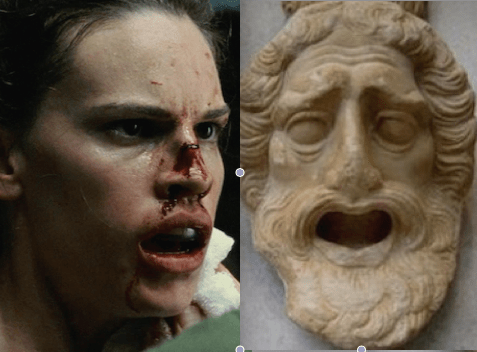
    In the second part of the film, after Maggie’s unexpected fall, it is useless to struggle with the tears. The spectators are swept up by sorrow as they see the strong, free-spirited female boxer turn into a complete invalid; it is almost impossible to imagine how she feels. Exactly as Aristotle defines tragedy, “arousing pity and fear”, the viewers are overwhelmed with compassion and horror, thinking that this could happen to them too. When the film ends, the effect of the cathartic moment is apparent: “Thank god I am not paralyzed!”

    In the making of this film, Clint Eastwood follows closely most of the principles of ancient Greek tragedy. First, it deals with comprehensive themes – love, pride, loss. The protagonist, a tragic hero, commits either a crime or a mistake, often without acknowledging how foolish and arrogant he has been. The nature of his crime is often related to hubris, to vanity. He then slowly understands his mistake, as his world crumbles around him. And also – the tragic hero is essentially a good man. The downfall of a villain would not produce the desired effect of horror and pity. But witnessing the complete destruction of a good man is heartrending and terrifying.

    In Million Dollar Baby, Maggie, the protagonist, totally wins our hearts. Her determination and courage, together with her honesty and devotion to her family, make her utterly lovable. She convinces Frankie (himself also a tragic hero) to coach her. He makes her repeat over and over again that the first rule of boxing is to always protect yourself! Her ongoing success, the tough opponents she overcomes, the cheering crowd, all make her self-confident, to a point where she becomes careless. In a single moment of hubris, she makes the hamartia, the critical mistake: she turns her back to her opponent, who then strikes her and she falls.

    As in every Greek tragedy, fate plays a crucial part. Maggie could have fallen in the ring; but as she falls, her head bumps into her stool and she breaks her neck. This peripateia – the unexpected turn of events – reroutes the plot to an altogether different direction.  Lying paralyzed in bed, she acknowledges her mistake: I didn’t protect myself, this was my mistake, I didn’t follow Frankie’s orders. The audience reaches a full catharsis in the moving final dialogue between her and Frankie and the last kiss before he takes her life.

    There is, however, one central feature of Greek tragedy that Eastwood completely ignores. The vast majority of Greek tragic protagonists are people of the upper class. Million Dollar Baby is a film about lower-class Americans. The boxing club is a run-down gym in Los Angeles; Maggie lives in a shabby room and works as a waitress in a diner, from which she takes left-over food to eat at home. She has come to Los Angeles from a god-forsaken town. Her overweight mother makes a living from deceiving the social security; her brother is in jail. There is absolutely nothing noble about poverty in this film; it is ugly, vulgar, and callous.

    So for what sin is Maggie punished? From a modern perspective, she is trying to fulfill the American dream: to overcome her poor background, to surmount the pettiness of her family and a sense of purposelessness, to achieve the impossible: to become a successful boxer at the age of 31. In simple, everyday words: she wants to make it.

    But she fails.

    Her depiction in the context of a Greek tragedy illuminates her character in heroic tones, making her comparable to classic protagonists. According to Eastwood, the exhaustive, back-breaking – and yes, valiant — efforts of lower-class Americans to succeed are bound to fail.  They can either accept their poor condition or end in self–destruction.

    The American dream is, indeed, only a dream.

  • Feminine vs. Masculine – The Rokeby Venus

    Feminine vs. Masculine – The Rokeby Venus

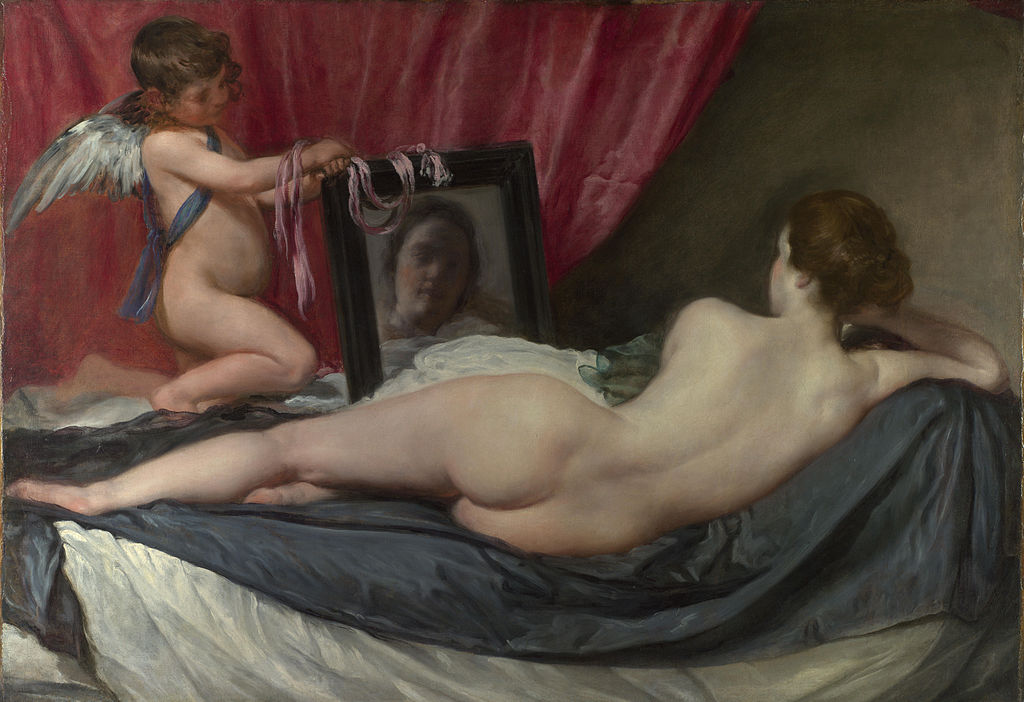
    Sometime a work of art becomes implanted in our mind because we find it disturbing. Not that we do not acknowledge its greatness, the artistic grandeur and the stylish finesse, but there is something about it that touches us in an unpleasant way, evoking discomfort, perhaps even anxiety. When I first saw the Rokeby Venus (known as ‘The Rokeby Venus’ since it was part of an art collection in Rokeby Park) I felt some agitation, and simply couldn’t figure out where it was coming from. Venus, as we all know, is the embodiment of love and beauty, and is often depicted in works of art. But the Rokeby Venus, a huge picture covering an entire wall at the National Gallery, created a strange turmoil.

    The Spanish painter Diego Velázquez (1599-1660) painted the female nude in spite of the vehement opposition of the Spanish Inquisition. He created this painting between 1647 and 1651, and was determined to depict the female body in the most realistic and vibrant manner.  In a way, this picture is an attempt to address human sexuality – not in a vulgar way, but through a portrayal of the most exquisite female ideal. Venus, the Roman goddess of love, beauty and fertility, is recumbent on a couch, watching a mirror – two gestures typical of her depiction in art – as Cupid, her son and the god of physical love, holds the mirror in front of her. Though she appears to be gazing at herself at the mirror, her eyes reveal that she is, in fact, watching the viewer.

    Art historians often argue that the distinct nature of the picture derives from its simplicity – it has no embellishments and hardly any decorations. Both Venus and Cupid are portrayed very realistically, a woman and a young boy on a couch.

    I tend to disagree with this argument. Indeed, there are no jewels and accessories, yet the embellishment—almost adoration—of the female body is embedded in the exposition itself: Venus’s naked body is set on a black sheet placed over a white one. The black sheet, as is often noted, follows her body contours. The couch almost evokes an association of a shrine. It seems to me that Velázquez went out of his way to illustrate the beauty of the female body.

    So why did I find the picture so unsettling? After many deliberations I came to the conclusion that it includes two distinct perspectives: one feminine and the other masculine. They co-exist, creating an inner tension, which makes the viewers stare relentlessly at the painting.

    From a masculine perspective, Venus’s beauty is overwhelming. The delicate contours, the rosy undertones, the pale back, the light neck and temple, suggesting purity in spite of her sensual posture, the naked body contrasted with the black sheet – an ode to feminine perfection. This Venus is the embodiment of sublime seduction.

    Yet, examining the picture from a feminine outlook is an altogether different experience. First, there is the mirror. Venus seems unable to look at her body; she is gazing only on her face. Why isn’t her entire figure reflected in the mirror, but only the facial features? To me, it is nearly a feminist declaration: women find it hard to watch their naked body. Endless hours spent in front of the mirror are always about: do the clothes flatter me? Is the makeup right? Can my flaws be seen through the dress? Velázquez is depicting feminine estrangement from simple, straightforward female nudity. Men adore Venus’s naked body, but she is unable to look at it herself.

    To emphasize her inability to look at herself, even when she watches her face in the mirror, she appears to see nothing but a blurred image, with uneven colors. And a close examination of her gaze, which should have been directed forwards, reveals that it is traveling to the viewer. In essence, it is a portrayal of a beautiful woman who is unable to look at her body and face and see its allure.

    And also, her beautiful body is placed on the black sheet as if it were an object. We don’t really see her facial expression, thus her emotions remain concealed. If we ignore for a moment that it is Venus, and imagine, for the sake of the argument, that this picture was created in the 21st century, we would probably perceive it as chauvinistic.

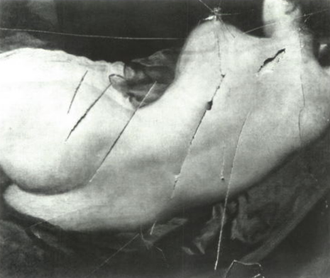
    So which perspective should we adopt? The feminine or the masculine? They are both there, within the picture, evoking two contrasting sets of emotions. Most viewers look at it bewildered, admiringly yet with some unease.  In 1914 an English suffragette slashed the picture with a knife, badly damaging it.

    Velázquez was, I believe, a man ahead of his time. His intricate, complex drawing of female nudity, in spite of the Inquisition’s threats, reveals a desire to address the psychological aspects of female and masculine sexuality, to outline the difference between them. The hazy face in the mirror, with the eyes secretly watching the observer, may well have been one of the earliest manifestations of modern feminism.

  • On Zionism and Gender – The Young Women’s Farm

    On Zionism and Gender – The Young Women’s Farm

    Women today find it hard to unite for the sake of a common cause. I mean, really unite – not simply share views on social networks, go to empowering women’s meetings, or vote for candidates who vow to promote feminist issues. Most of us, I believe, feel that in the daily struggle with discrimination we stand alone. We may gripe about it, take some action once in a while, but nothing more. However, profound social change probably requires an altogether different sense of commitment.

    A relatively unknown part of Zionist history is the role of women – their aspiration to be equal partners in this revolutionary movement. ‘Revolutionary’, because Zionism aimed not only to create a homeland for the Jewish people but also to change the Jewish character, to form a ‘new Jew’ (the ‘Sabra’). Those early Zionists saw the Jews living in the Diaspora as weak and unproductive. The ‘New Jew’ would be strong, able to defend himself, and productive. And in the eyes of Herzl and his contemporaries, productivity meant one thing: engaging in agriculture.

    In the late nineteenth century some Jews from Eastern Europe settled in Israel, then Palestine, with the hope of fulfilling the Zionist vision. First came some families, and then groups of socialist single men – with a very few young women – eager to make the barren land bloom. The Arab-Israeli conflict was still in its infancy. The real threats were death from starvation or malaria.

    The women – the very few who dared to travel to this god-forsaken place – were expected to work in the kitchen, wash the men’s clothes, and perhaps engage in some limited home-based farming. To be historically fair, this was before voting rights were granted to women both in the UK (1928) and in the USA (1920). But some of these girls were determined to take full part in the Zionist endeavor.

    In 1911 Hannah Meisel, a Russian immigrant with a PhD in agronomy, decided to establish a women’s farm, an agricultural training institution for young, unmarried women. She called it ‘The Young Women’s Farm’ (Havat ha’almot). Leasing a room from a Jewish settlement next to the Sea of Galilee, she came with two students; four others joined her later. The girls, sixteen or seventeen years old, were eager to master every theoretical and practical aspect of agronomy. 

    You would think the young men already settled there would have welcomed them. They did, but only as long as they were willing to take care of the cooking and laundry. At first the girls and the teacher lived in one room, with neither floor nor windows, but eventually the school had its own house. And other girls quickly followed the first students. The rumor of this revolutionary school for young women spread in Zionist circles, to the point that Hannah had to reject some of the applicants since there was room for only twenty girls at a time. One famous student was Rachel the Poetess.

    The girls worked in the fields for eight hours a day and their evenings were devoted to general education. They specialized in growing unique kinds of orchards and vegetables. They established a nursery that provided hundreds of olive, lemon, almond, and eucalyptus seedlings for other farms. They began the experimental planting of bananas, today a common crop in this part of Israel. Their eucalyptus trees were used to dry the swamps that inflicted malaria and other diseases. They had a productive dairy barn, and the decorative flower garden was another of their innovations.

    Hannah, in spite of her revolutionary spirit, was an extremely practical person. She thought that after two years of schooling the girls would marry and settle down with a husband and children, and therefore insisted they should also learn ‘household management’: cooking, sewing, cleaning. Her aim was to create a farmer’s wife with some agricultural skills.  But the girls, now an integrated group of determined young women, who had endured hardships and maladies, developed an altogether different image of their role in society. They wanted to engage in agriculture as their main vocation, not just for the sake of supporting a husband.

    The protests against ‘household management’ evolved into an open rift with Hannah, whom the girls now called ‘our older sister’. “What sort of subject is that?” they wondered. Some cleaned the kitchen out of respect for her, others openly refused, and some pretended to clean it but left the oven and pots dirty. The spirit of feminism that developed within the group could not be shaken even by the fierce stand of the respected teacher.

    It is most likely that if Hannah had had only one or two students, they would have adopted her worldview. But the united group she created formed new perceptions of gender role, more radical than her own; they wanted a new life style. Their mutual support made the different, innovative feminine identity possible. In many ways they were ahead of their time, a true ‘avant-garde’.

    The women’s farm lasted for six and a half years. The outbreak of WWI created new, insurmountable obstacles. Yet the determination and collective spirit of these young women had a profound and long-lasting affect on women’s role in Israeli society. If you had asked Hannah, she might have said their influence was somewhat too extreme.

  • Hannibal Lecter – a Psychopath or the Devil?

    Hannibal Lecter – a Psychopath or the Devil?

    There is always something entertaining about watching a good thriller. Not in the simple sense of the word, the suspense can be nerve-wracking, the terror almost unbearable, the violence scary, the spectator is waiting breathlessly to see if a heinous crime can be prevented. But it is entertaining in the sense that it isn’t meant to provoke deep thoughts or contemplation, but to create satisfaction that the mystery is solved, the criminal arrested, that the increasing tension is brought to a catharsis. The vast majority of spectators would never suspect religious ideas to be concealed within popular thrillers.

    But a closer look at some of them may be surprising. Take, for example, The Silence of the Lambs, a thriller based on Thomas Harris’ novel, released in 1991. It is an extremely popular film, one of the few to get five Oscars at the Academy Awards, a huge box office success. Millions of spectators around the globe are horrified by the cruel and ruthless Hannibal Lecter. So what is it about this character that catches the imagination of so many? What makes him unique among a multitude of criminal characters appearing so often on our screens?

    Perhaps it has to do with him fitting perfectly into a well-defined cultural pattern of evil set in our mind: that of the devil of the Judeo-Christian tradition. Our image of Satan has some very distinct characteristics: he is a stranger, wandering upon the earth. He is vain and deceitful, an embodiment of the sin of hubris. He can assume various appearances, some extremely attractive, standing in sharp contrast with his evil nature. He has a unique insight into the human soul. He is often physically deformed. And, of course, above all, he is the embodiment of ultimate evil, which will always prevail. He cannot be understood through psychological means; he is an eternal opponent of God, his evil provoking not only fear but also awe.

    Now, take a look at Dr. Hannibal Lecter. In The Silence of the Lambs we don’t know where he came from, he has no family or friends. (Later, in Hannibal and in Hannibal’s Rising, Thomas Harris added more information about his life; many see them as reduced forms of Hannibal, and certainly not as popular.) Regardless of his imprisonment in humiliating conditions, he manifests contempt towards others. A refined character also in prison garb, as he escapes he skins one guard and covers himself with his face, and at the end of the film he looks like an attractive tourist, wearing a hat and sunglasses. In the novel he is depicted as having a six-fingered hand. His cannibalism is a relatively rare quality of the Christian devil, though Giotto depicts Satan eating human beings. It could be his way of desecrating the Eucharist, transforming the spiritual union with God into a savage eating of human flesh.

    And why exactly does the police ask for his advice? Surely there are other psychiatrists to consult. It is generally believed that he has an inner knowledge of the human soul and thus would be the only one who could understand the twisted logic of a psycho killer the police it trying to find. Clarice says “he damn sure sees through me,” and he observes she has a new band aid, without being able to see it. And above all, he says about himself: “Nothing happened to me, Officer Starling. I happened. You can’t reduce me to a set of influences. You’ve given up good and evil for behaviorism, Officer Starling. You’ve got everybody in moral dignity pants—nothing is ever anybody’s fault. Look at me, Officer Starling. Can you stand to say I’m evil? Am I evil, Officer Starling?” The spectators’ awe springs from their acknowledgment that no matter how hard people try to imprison him, he will escape

    And there is a pact with the devil that Clarice makes. Traditionally, the devil wants the soul in the afterlife in return for granting a wish in this world. Here, perhaps a modern devil, Hannibal asks Clarice to reveal her childhood memories and traumas—her soul—and in return he will help her find the murderer.

    Hannibal has been called a psychopath, sociopath, monster, Dracula—but interpreting him as a devil is fundamentally different. It is not merely descriptive, it sets the entire plot within the realm of “good” and “evil,” on moral grounds. As he says, no one judges anything in terms of right and wrong anymore, it is all about psychological analysis now.

    Perhaps this is the heart of the outstanding success of The Silence of the Lambs: the spectators identify, even if unconsciously, a well-known cultural pattern, a character that feels so familiar, they simply know Hannibal is different from all other villains appearing on the screen. When they see his vanity, his power albeit his imprisonment in a small, dark, secluded cell, they know he will manage to escape; absolute evil, as we all know, can never truly be eliminated.