
Tag: holocaust

  • A Horse Walks into a Bar – The Second Generation

    A Horse Walks into a Bar – The Second Generation

    The term “second generation,” for children of Holocaust survivors, has become inherent to Jewish identity, referring to those who did not themselves experience the Holocaust but whose lives have been shaped by the unbearable traumas suffered by their parents, generating common fears and integrating the Holocaust into their worldview. The term refers not only to son and daughters of concentration camps survivors, but also individuals whose parents experienced various aspects of Nazism, and extends even to students of the very small and intolerable details of the atrocities. All are a part of the generation living in the shadow of the Holocaust, though born after it was over.

    The brilliant book by David Grossman, A Horse Walks into a Bar, which earned him the International Man Booker prize, deals with this phenomenon. It is a rich, multi-dimensional novel with universal implications; a substantial part of it depicts a childhood and adolescence shaped by the Holocaust. The protagonist, Dovale Gee, is a stand-up comedian performing in a basement in Netanya, revealing details of his life to the audience. He invites a childhood friend, a retired judge, whom he hasn’t seen for forty years, to “judge” his performance, which unearths his life story. At first, the spectators—and with them, the reader—are led to believe it is an ordinary stand-up show, though unusually vulgar. Gradually, though, we learn about the early trauma experienced by the comedian. Most spectators leave, though some stay, eager to take part in and understand Dovale’s most difficult and meaningful moments.

    Dovale is the only son of a Holocaust survivor. His mother hid for months within a train car. “She spent six months of the war in a small train car, I told you that. They hid her there for half a year, three Polish train engineers in a little compartment on the train that ran back and forth on the same tracks. They took turns guarding her; she told me that once, and her face wore this little crooked laugh I’d never seen before.” After six months, they threw her “straight onto the gatehouse ramp,” where she fell into the hands of Doctor Mengele. His father escaped from Europe right before the war broke, but his entire family was exterminated.

    Dovale’s childhood experiences often refer to the Holocaust. For example, when he is sent to a Gadna (youth training) camp at the age of fourteen, he is terrified. It feels like going abroad, but “going abroad wasn’t done then, definitely not by our sort. Overseas, for us, was strictly for extermination purposes.” But it is the end of the story that illustrates the profound influence the Holocaust had on the “second generation”: when in a Gadna camp, Dovale is told that he has lost a parent, but no one tells whether his mother or father has passed away. On his way back to Jerusalem, he delves into a miserable calculation: who would he prefer to have died? Mom or Dad?

    How is that connected with the Holocaust?

    The desire to rank the atrocities of the Holocaust in order of importance or significance is, of course, wrong. One cannot weigh and measure the innumerable sufferings the Nazi mechanism generated. It is impossible to determine what was more or less terrifying. An analysis of various tortures turns into what is often called “a pornography of death,” dealing with details but missing the main point. But in spite of that, I feel that the worst torment some survivors had to go through was a command to choose between family members, as with Sophie in William Styron’s famous book, to choose who would live and who would die. Sometimes parents were given the opportunity to save one child, and they had to choose who would be sent to the gas chambers and who would be saved.

    David Grossman shows how this monstrous aspect of the Holocaust gradually becomes part of his protagonist’s life. Nazis forced Jews to make an impossible decision: who would be better dead, and who would be better to save. The first-born son? The youngest? Mother?  Husband? The possibility of such an unthinkable, atrocious contemplation had become part of our world. Acknowledging that someone forced our parents, remote family members, or even Jews we didn’t know, to decide which member of the family would live and who would die implied that this option existed and cannot be ignored anymore. It becomes an element of our self-perception, our common consciousness, even as we recognize it as detestable. The climax of the novel relates when, at the age of fourteen, Dovale is trying to “decide” who he would rather find out had died, father or mother, is nothing but a natural extension of the “second generation” experience, applying the tragic ordeals of the parents to the lives of the children long after the Holocaust was over.

    A word on the link between the comic and the tragic: Prof. David Flusser, my instructor at Hebrew University, grew up in Prague and knew some of Franz Kafka’s childhood friends (Kafka is mentioned in the novel). He told me that one of them described to him the details of the very first time Kafka read his work to his friends and they all burst into wild laughter and couldn’t stop. What eventually became the ultimate literary expression of the indifference to the fate of man and of impersonal cruelty was, at first, funny. So is David Grossman’s novel. But, unlike Kafka, he tempts the reader with jokes and gradually transforms his world into a dark and cruel place. The joke is the last resort, a means to escape the understanding that someone had to decide who of his family members would live and who would die. And Dovale, exactly like Kafka’s Joseph K., is awaiting the verdict for a crime he did not commit.
  • Falling into Nazism

    Falling into Nazism

    There is something enigmatic about the way the Nazi regime came into being. I am not referring to its profound historical sources, but to the gradual transformation of Germany from what seemed like a normally functioning society into one that endorsed a state of ecstatic devotion to a ruler, a nation, a race, an ideology. The shift of values and habits is intriguing, especially when we compare the early manifestations of Nazism with the end result – WWII and the Holocaust. In retrospect, Germany underwent a comprehensive change. But was it possible to grasp the enormity of the transformation as it was taking place?

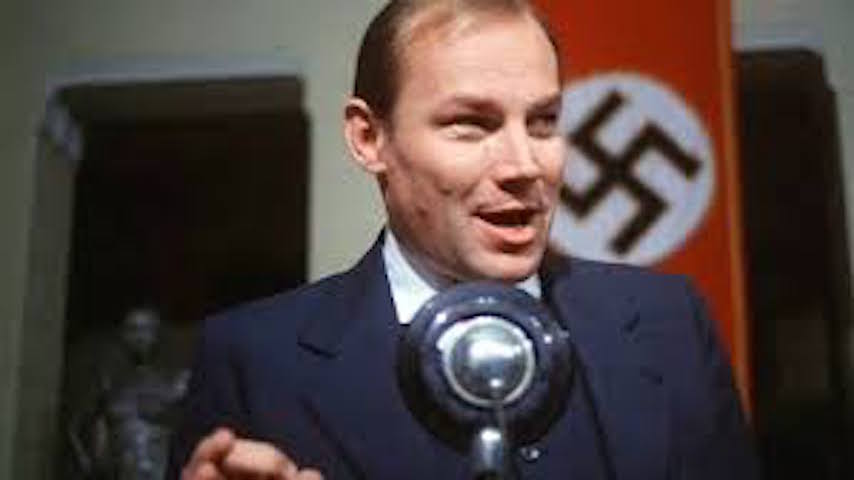
    Klaus Mann (1906-1949), a German writer and publicist, began writing his well-known novel Mephisto in 1933 and concluded it in 1936. A fierce opponent of National Socialism, the son of Thomas Mann and brother of Erica, he fled Germany in 1933 to reside in Amsterdam and in the United States. His public criticism of the Nazi ideology made Nazi Germany strip him of his German citizenship. Mephiso, later adapted as a film, focuses on the psychological mechanism of adjusting to a new spiritual atmosphere, a new regime.

    The protagonist, Hendrik Hoefgen, is an ambitious young man. At the beginning of the novel he is a young actor with a revolutionary spirit, supporting Communist groups; at the end he is the head of the German National Theater in the Nazi era. So how does a man who publicly opposed Nazi ideals become part of the Nazi establishment?

    Mann’s answer is subtle gradation: a very slow and gradual process of moral decadence, in which every step appears almost plausible. There is no one moment of moral collapse, of adoption of racial or anti-Semitic ideas, only a very slow process of adjusting to a new regime, gradually adhering to its standards.

    When Nazi ideas begin to spread, the young Hendrik gets a role in a major theater in Berlin. He openly denounces racism, calling Herman Goering’s girlfriend, herself an actress, ‘a stupid cow’. As the Nazis are gaining power, he is shooting a film in Spain. The director cancels the making of the film. His friends and wife decide to leave Germany – but not him. His burning ambition to become a famous artist, well-known and wealthy, makes him persuade himself that free art will always survive, regardless of political developments.

    Strangely, Goering’s girlfriend, oblivious to his past remark, asks him to appear on stage with her in Berlin. Hoefgen hesitates, but the professional temptation overshadows everything. He returns to Nazi Germany to play with her, also becoming acquainted with Herman Goering. The latter grants him the role of Mephisto in Goethe’s Faust. He even attends the opening gala; in the intermission he invites Hoefgen to his stall, shaking his hand as the audience watches. At that very moment Hoefgen becomes a famous actor. “How easily everything went! Hendrik feels he must have been born under a lucky star! … Should I have refused so much splendor? No one else would have done so given the same opportunities; and if someone was to claim otherwise, I should denounce him as a liar and a hypocrite.”

    The next step is using Goering’s affection to save an old friend who was engaged in anti-Nazi activity. He takes pride in saving his friend, but not only in that: “I have rescued a man, he thought proudly … But might there not be a day of upheaval and great wrath? In case that happens it would be wise – and indeed necessary – to take insurance. The good deed constituted a particularly valuable insurance policy. Hendrik congratulated himself on that.” He is cold and calculating. Should the Nazi regime collapse, it would be wise to be able to justify his collaboration with it.

    When Goering is about to eliminate Hendrik’s black mistress, he manages to have her deported to Paris. He meets her in her dark prison cell, before deportation, warning her: “There is one condition attached to this great favor … you must keep quiet! If you can’t keep quiet then it’s finished for you.” He now explicitly threatens a woman he cherishes dearly.

    His appointment as head of the National Theater is a moment of personal triumph; he remarries and lives in extravagant wealth, yet members of the underground threaten him: “we will know who to hang first.” His shaken sense of security leads to his emotional collapse, and, in tears, he cries: “what do they want from me? … All I am is a perfectly ordinary actor.”

    This last sentence encapsulates Klaus Mann’s historical observation: many Germans who were not ardent Nazis yet fully cooperated with the Nazi regime did not accept the moral responsibility for their deeds. The gradual development of the adherence to Nazism made the avoidance of a full reckoning possible. Hendrik may have even argued that he was a victim; but Nazism couldn’t have thrived without people like him.

  • Arc de Triomphe: Israel and the Holocaust Trauma

    This article was published in ReformJudaism.org

    The Arc de Triomphe, the grand monument at the heart of Paris, was build to celebrate victory. It honors those who fought and died for France in the French Revolution and in the Napoleonic Wars, but their memory is part of a happy moment of enjoying their achievements, a symbol of their victory.The many tourists that come to see the Arc every day are reminded that in spite of the many sacrifices, France won.

    The drive to celebrate a triumph in an act or gesture which has no practical aim other than demonstrating the joy of winning is part of our culture. It can be a collective act, like building a monument or throwing a grand ball, or it can be a personal expression, or decision. The Romans had Songs of Victory; in the Middle Ages rulers sometime celebrated a triumph with a popular fair. Military parades often follow a victory—in 1945 the Allied soldiers marched in the streets of Berlin in a victory parade. 

    As a child, I often wondered why my father smoked. When I asked him what had made him take the first cigarette he replied: when I heard that Nazi Germany had surrendered I felt a need to do something that would demonstrate that the constant oppressive strain of the war was over, so I lit a cigarette. Though unfortunately it was the source of an unhealthy habit, I could always imagine this moment of utter relaxation—the war is over, Germany was defeated, now is a time to smoke a cigarette.

    The need to celebrate the victory over the Nazis still exists in contemporary Israel. Various delegations travel to concentration camps, walking with flags of Israel and conducting ceremonies in memory of Holocaust victims. High schools, universities, the Israeli army – they all send hundreds of young men and women to Poland, mainly to Auschwitz.

     I always feel some resentment at this demonstratively triumphant walk in the concentration camps. I certainly understand its motivation; growing up in a Zionist home, I was often told by my parents that our true victory over the Nazis is the very existence of the Jewish state. But walking with Israeli flags next to the gas chambers seems to me unfitting.

    There are some instances in which speaking of victory is simply impossible, it is a categorical mistake. Any referral to the Holocaust in terms of a triumph is, in my opinion, completely erroneous. Victory is applicable to a struggle between two forces that even if not equal, are at least comparable. First there is a confrontation, then one side wins. The Allies defeated Germany in World War II. But in the case of the industrialized genocide of the Jewish people, men, women, and children were simply led to their death, with only a remote possibility of escaping the gas chambers. Thus, there is no room for a spiritual “Arc de Triomphe” in the concentration camps; it should evoke contemplation, and perhaps also tears.

    And also, if the triumph over the Nazis is to be celebrated, why there? Why in the concentration camps? If the true victory is the state of Israel, there is no point in celebrating it in Auschwitz. It is not a cemetery; the victims were not buried respectfully but murdered and cremated. If the collective memory is the purpose, the Yad Vashem museum in Jerusalem has an impressive collection of artifacts and documentation of the Holocaust. And as for education, one doesn’t have to travel around the globe to learn about historical events.

    After many deliberations on this matter, I believe that my resentment springs from a sense that the very need to come to Auschwitz reveals the depth of the trauma the Holocaust has created, even in young people, whose grandparents were possibly its victims Those ceremonies and flags seem to me more like an exposure of weakness than like a resounding victory. They are driven by a desire to prove to others, even if they are not physically present, that we prevailed.

    Youngsters and also adults often write about their experience in the concentration camps. They describe themselves clinging to each other, shivering as they see the horrors of the industry of death. Frankly, what each and every one of them is thinking is: what would have happened if I had been here? Would I have behaved differently? Would I have revolted? Would I have tried to escape? Would I have attempted to save my parents and siblings? Would I have died, like everyone else?

    It is here that a true victory is needed; and no ceremony in Auschwitz will grant it. This battle is an extremely difficult one. As the great English poet William Blake wrote: “Father, Oh Father, what do we here/ In this land of unbelief and fear?”