Tag: matisse

  • A True Portrait? Greta Moll

    A True Portrait? Greta Moll

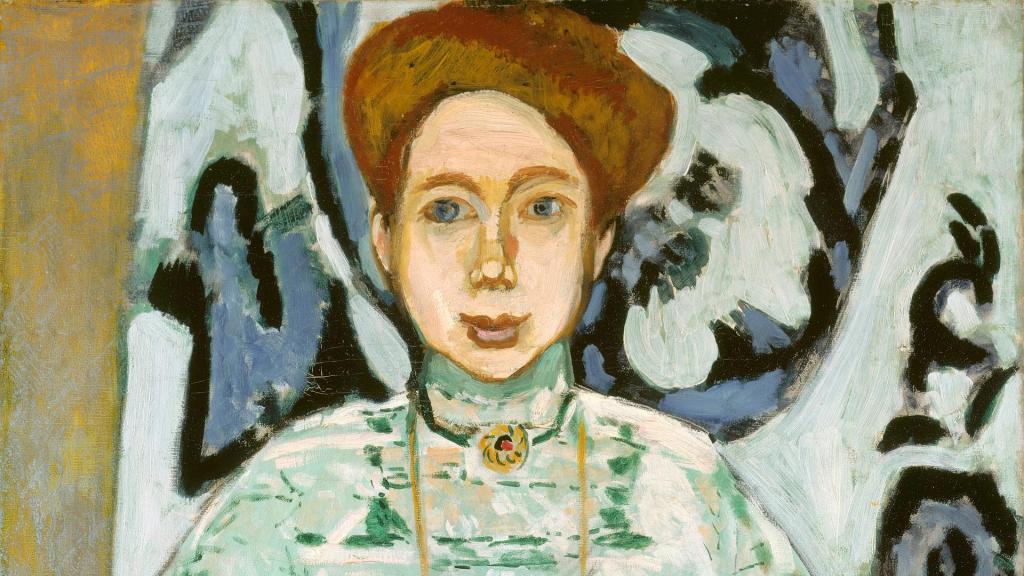
    When I saw the ‘Portrait of Greta Moll’ in the National Gallery I was taken aback. I felt that her character somehow overshadows her artistic presentation: a penetrating look with a touch of humor, a light—yet reserved—smile, curious inquisitive eyes wide open, the feminine roundness of the body leaning almost incidentally against the orange table, impatient, generously allowing Matisse to paint her yet eager to go. She seemed to me so independent and free spirited; in a minute she would stand tall, take her farewell and leave the artist longing to complete the portrayal of her unique character.

    Greta Moll (1884-1977) and her husband Oskar were part of a very small group – ten people at most – of Matisse’s original students. Greta was a German sculptress, painter and author. Her appealing appearance, her free spirit and intellectual and artistic talents captivated the attention of many. Matisse decided to paint her after seeing a black-and-white photograph of a her portrait made by the German artist Lovis Corinth. Looking at the photo he declared, with open contempt, that Corinth had failed to represent her ‘youthfulness’. Taking up the challenge, he suggested he would himself make a portrait of Greta.
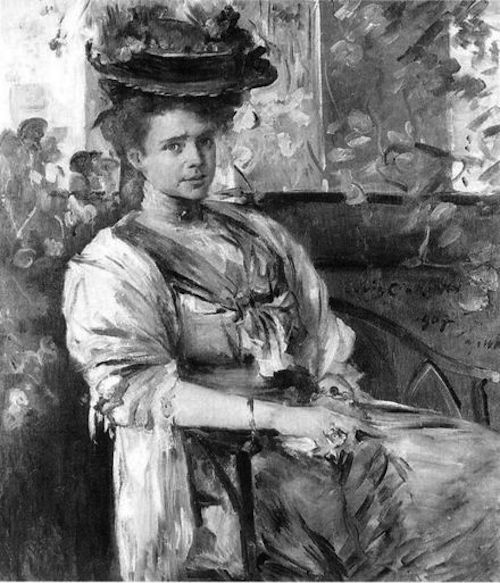
    Marg Moll by Lovis Corinth
    Marg Moll by Lovis Corinth

    This was Matisse’s first commissioned portrait. It was painted in the spring and early summer of 1908, in his studio in Paris. Rather pragmatically, he insisted that Greta and her husband should be charged 1,000 francs, but they wouldn’t have to buy the picture if it failed to please them. Portraiture, Matisse knew, is a tricky form of art. It consists of two conflicting elements: a desire to please the subject of the painting, to present him or her in an appealing manner; but also to portray a mood, a state of mind, qualities that might not appear at all attractive. Greta would certainly like to look beautiful. He, however, would venture to unearth her unique quality, perhaps in a way that would fail to appear ‘beautiful’.

    The Portrait of Greta Moll may appear simple, almost as if it was made with a couple of swift brushstrokes. But Greta posed for ten days, three hours every day, until it was ready. Matisse didn’t allow her see the unfinished work. But after ten days Greta and Oskar came to the studio, where Matisse unveiled it. They were full of admiration: Greta’s blue eyes and blond hair (which Matisse used to say reminded him of ripe corn or honey) were pretty, she looked lovely, charming and feminine. The couple, eager to take the portrait, expressed their full satisfaction. Both the artist and the model agreed that the portrait was strikingly like Greta, and the couple went home pleased.

    But not Matisse.

    He felt he had failed to capture Greta’s unique character, “In spite of my best efforts…. I had gone no further than the charming features which were not lacking in my model, but I had not managed to catch her statuesque aspect.” This was all wrong. The more charming she appeared, the more falsified the portrait was. Greta had something overwhelming about her, she wasn’t only ‘a beauty’. And portrait painting is the art of unearthing profound aspects of an individual, an inner world, rare perspectives.

    Matisse wasn’t sure how to fix the portrait. But he recalled a painting he had seen in the Louvre, La Bella Nani, by the sixteenth century artist Paulo Veronese. After Greta and Oskar left he rushed to the Louvre to see it. “The proportions of the model were almost the same as Mm. Moll’s”, he later wrote. Standing facing La Bella Nani he found what had been missing: grandeur, an expressive gesture of the hands, an intense gaze. The freedom of the Renaissance artist to portray drama and intensity of emotions made him aware the limitations of his own work. Naturally he wasn’t going to adopt the Renaissance style; he only wished to extract a certain quality from the painting, and grant it a modern expression.
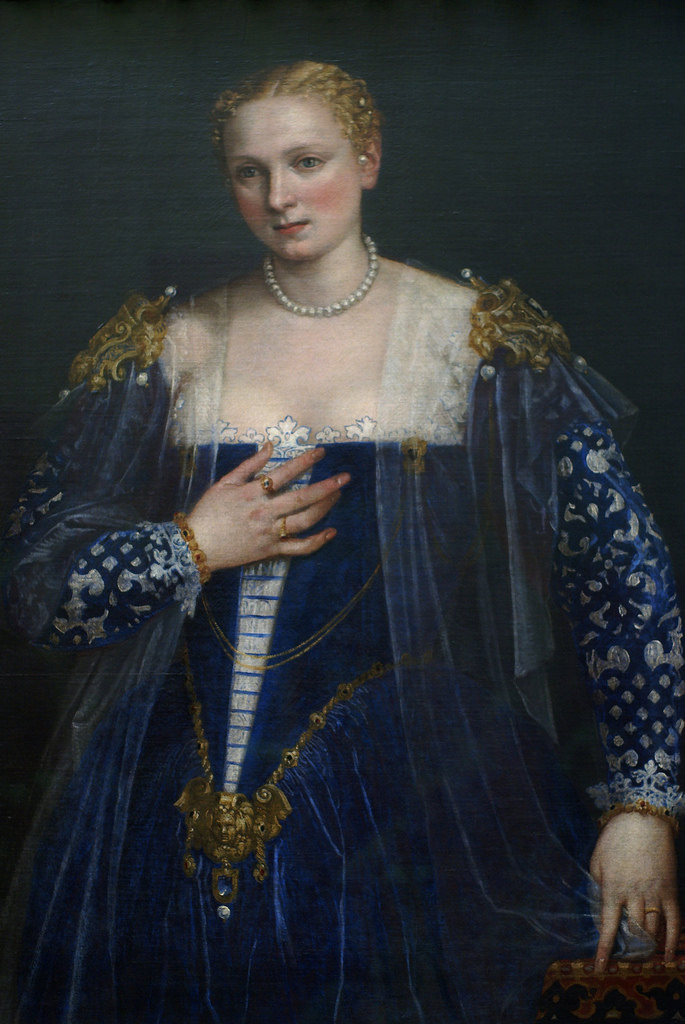
    La Bella Nani by Veronese
    La Bella Nani by Veronese

    Matisse went back to the study and began working on the portrait. After an hour it was dramatically changed: the woman’s colors and features were intensified, details suppressed, the arms became massive, Matisse had given her a modern grandeur, the “statuesque quality” he was looking for: “abandoning all caution, I worked on it for an hour, perhaps two, ending up with a feeling that I had been most satisfactorily delivered.”

    When Greta and her husband saw the finished portrait they were devastated. She was appalled by the huge arms and the bushy eyebrows. They missed the blond curls and the delicate colors. But they decided to keep it. And gradually Greta connected with herself as she was portrayed by Matisse, and came to love the painting. She was later quoted as saying “I could kill a man who owns it in order to call it mine.”

    I find the portrait overwhelming. And Greta seems to me imposing, whatever her hair, eyebrows and arms looked like.
  • Bewildering female Nude

    Bewildering female Nude

    The perception of the female body is one of the most intriguing and controversial questions of the modern age. Painters, sculptors, photographers have all tried to portray it in insightful and innovative ways: realistically, impressionistically, as an object of desire, as decoration, as an abstract idea; there are endless depictions of nude women, each unearthing a new, unfamiliar aspect. Strange that a thing so familiar – either our own body or that of a partner – remains a mystery that constantly requires explanation. What is it about a woman’s body that evokes this drive to interpret it?

    Henri Matisse (1869-1954), a French painter and sculptor, was one of the artists who shaped twentieth-century art. Active for nearly six decades, he left a huge and versatile body of work. His firm belief that art should constantly be changing made him explore with colors, shapes, light and shade. Often changing his style, and followed by other artists, he was a leading figure in modern art.

    I admit I find his works rather intriguing; people are deeply impressed by paintings that seem to betray a conscious attempt not to gratify the spectators. His works are focused on the process of making art, and at times seem to completely ignore its viewers. They are very expressive, using colors in a unique manner, but not in ways that attempt to please the eye.

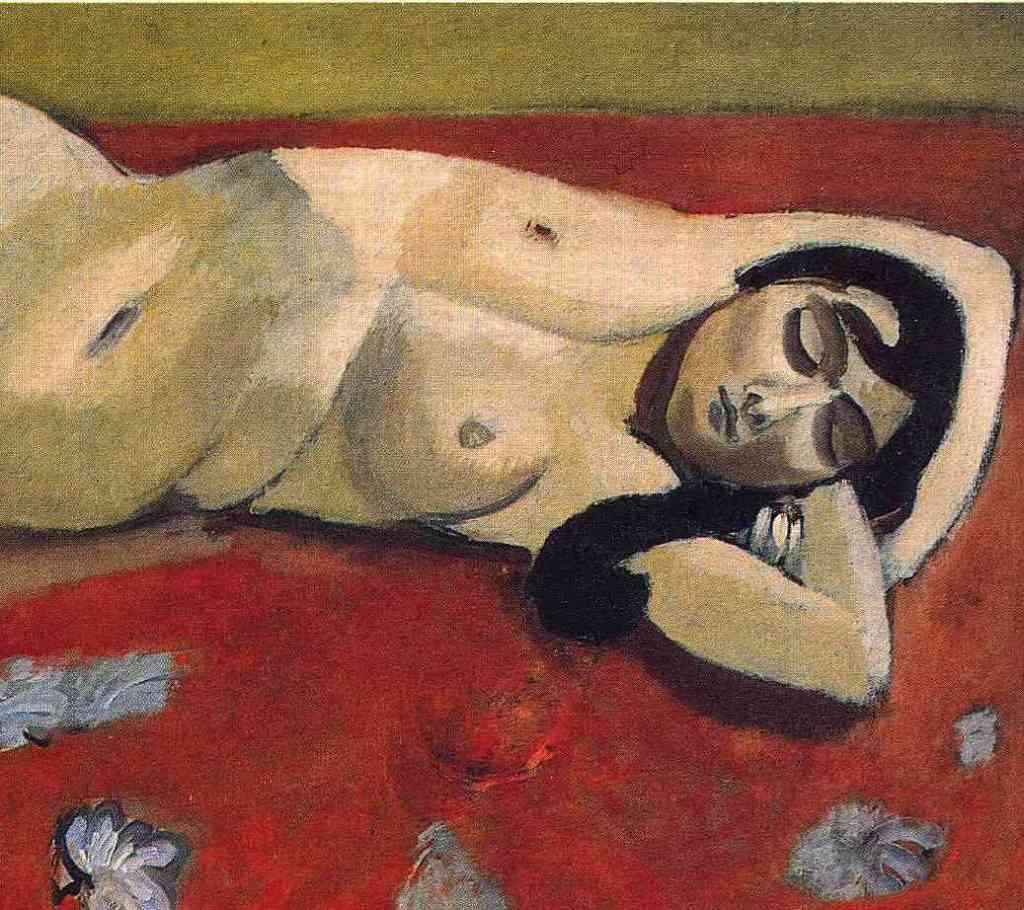
    Sleeping Nude on a Red Background was created in 1916. Art historians divide his creative years into periods: the early years, Fauvism, the embattled artist, the time he spent in Venice, the Soviet Union, America, his last years. 1913-1917 were highly experimental years, during which he pursued a radically new and inventive approach to artistic production. It has been argued that during this time he made the most challenging experiments of his career. In 2010 the MoMA and The Art Institute of Chicago held a joint exhibition devoted to these years, titled “Matisse: Radical Invention, 1913-1917”.

    Describing himself, he defined his artistic work as “the methods of modern construction”, not only in terms of experimental techniques but also as a way of defining modernity. What does it mean to be modern? In these experimental years he made various attempts to portray the unique qualities of the modern worldview.

    There is something disturbing about Sleeping Nude on a Red Background. The model’s pose, a naked woman recumbent on a cloth, is consistent with the artistic tradition of a female body leaning against a fabric. Yet Matisse’s model has two conflicting qualities: on the one hand, parts of her are poster-like, lacking any depth. The black hair, the pubic hair and the black object in the back look almost as if they had been made with a black marker. Her body, on the other hand, is vibrant and realistic, in particular her abdomen, which may even suggest movement. But strangely, a careful examination reveals that the colors of her body “spilled” underneath her. It isn’t shadow but an extension of the body onto the sheet.

    Students of Matisse often refer to the innate ambivalence of his work: the past blends with the future, the depth of traditional art is combined with the flatness of modern art, figures of the past mix with the decorative nature of contemporary art. The art historian Alastair Wright argues that “his work sat on the knife-edge between the representational tradition of the nineteenth century and the formalist abstraction to come.” His attempt to define modernism can be extended to include an examination of the modern perception of the female body.

    On the one hand, the sleeping woman is merely an object: the hair and the pubic hair are of the same quality, like something placed there, in the background. She is very beautiful, but still, an object. On the other hand, her body seems so real, almost like an untouched photo of a woman her age, sleeping on a couch. In fact she is so ‘real’ that her vitality seems to spill beyond her contours. The fleshly aspect is very authentic, so sensual that it overflows her body. She is the embodiment of the modern dual view of the woman’s body: as both a sexual object and a liberated person, physically and emotionally.

    I wonder if this ambivalence prevents the eradication of the sexual objectification of women. Is female nude a manifestation of sexual exploitation or of liberation of women? Ambiguity is very difficult to overcome. If a woman’s body was only an object, it probably would have been easier to struggle with it. But this vague, unequivocal attitude – sometimes naked women are merely sexual objects, sometime nudity is one aspect of women perceived as whole human beings – is hard to defy. It certainly is a “modern construction”, as Matisse had put it. And deconstructing it is very difficult.

    Sleeping Nude on a Red Background is exhibited in Kunsthous Zürich.

    This article was posted on the Kunsthous Zürich Museum’s Facebook page on September 22nd 2015.