Tag: painting

  • Theme vs. Color: Degas’s La Coiffure

    Theme vs. Color: Degas’s La Coiffure

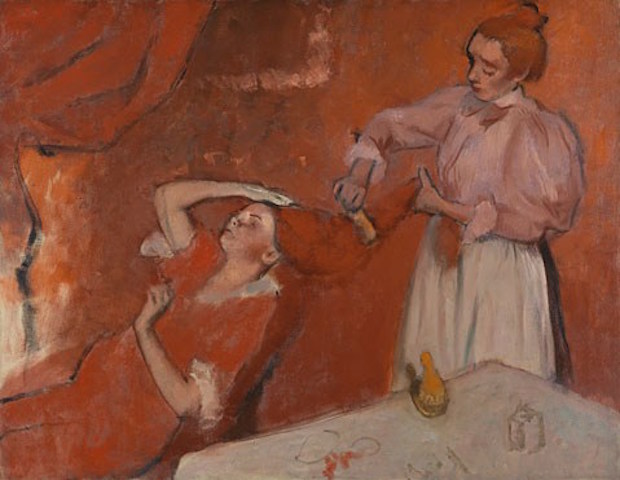
    What is more important – the theme of an artwork, or the artistic media used to convey it? The idea or state of mind an artist wishes to communicate, or the concrete choices of composition, colors, shapes? The complex relationship between an abstract idea and its materialization in art is a fundamental question in aesthetics; it has been discussed extensively in art history. The underlying assumption of these discussions is that there is a correlation between the two: artists use different tones and shapes to convey content, emotions, beliefs etc. They employ all possible artistic vehicles to create a certain effect.

    In my opinion, in La Coiffure  Degas wished to re-examine this common assumption

    Edgar Degas (1834-1917) was a French painter, sculptor, and also a photographer. A wealthy aristocrat by birth, he could engage in art without needing to attract buyers until the death of his father, after which he had to sell some paintings to cover his father’s debts. He is often associated with impressionism, though certain aspects of his work set him apart from his fellow impressionists – especially the carefully calculated composition of his paintings, and his reservation about painting outdoors. A fine draftsman, a superb portraitist, he was an artist constantly in search for a new creative path, attempting to blur the distinction between genres and mediums. It has been argued that his experience with photography shaped his choice of composition.

    Degas is often described as a ‘reclusive’ person, inclined to aloofness. Though he associated with other artists and was affected by them, it was hard to maintain a friendship with him. Renoir said: “What a creature he was, that Degas! All his friends had to leave him; I was the last to go, but even I couldn’t stay till the end.” A rigid conservative, an avowed anti-Semite, the Dreyfus Affair even further intensified his hatred of Jews. Though utterly remote from the image of an open-minded, tolerant artist, his creative spirit was indeed unique. It reached full fruition in his late years, when he was less inclined to naturalism and more to abstraction. La Coiffure was painted between 1896-1900, and was owned by Matisse.

    When I first saw the painting in the National Gallery I was stunned. The colors are so bright and vivid (though regretfully it is placed is a rather dark room); only rarely does one find such a colorful painting in a museum. Rich orange, red, some burgundy, it is overwhelming. But I also had a feeling that there was some error within the painting – like a coloring book painted without following the instructions. The same orange color was used for the dress of the young women, her hair, the back wall, the drapery, and there is even a stain of orange on her cheek. This choice, of using a similar color for close objects, is puzzling; it stands in contrast with a fundamental artistic convention – the differentiation of objects by color.

    The painting, then, contains both theme and ‘media’, but they are almost unrelated. Thematically, we see a young woman, and an older one – her mother or a maid- combing the long hair of the young one. Strangely, the hair seems almost like an independent being, belonging to neither of them. I would say the painting is about femininity, about who controls the sexuality of the young woman. Degas’ fascination with women combing their hair is well known. But focusing on the colors reveals almost a different painting: everything is orange besides the older woman, the face of the young woman – and the table. The young woman’s hair blurs almost completely into the blazing orange background. From this perspective, the painting is only about the older woman. Was Degas suggesting a social message here? Perhaps about the place of servants? There is no definite answer to these questions.

    The heart of this painting is its double nature. Degas differentiates almost explicitly between images and colors, between two aspects of the painting that are normally fully integrated: the huge bold orange color on the one hand, and the delicate, refined feminine hands on the other.

    Degas is often described by art historians as an “objective painter”: he neither identifies with the objects of his painting nor judges them. He aims at a very precise description of reality, yet one that contains anxieties, feelings, perceptions. That could hardly be applied to this painting, which is rather different from his normal reserved style. One would have to deduce that there is an emphasized element of abstraction here. Perhaps it is not about the brushing of the hair, La Coiffure, but about the process of materializing an idea in shapes and color, about painting itself.
  • Feminine vs. Masculine – The Rokeby Venus

    Feminine vs. Masculine – The Rokeby Venus

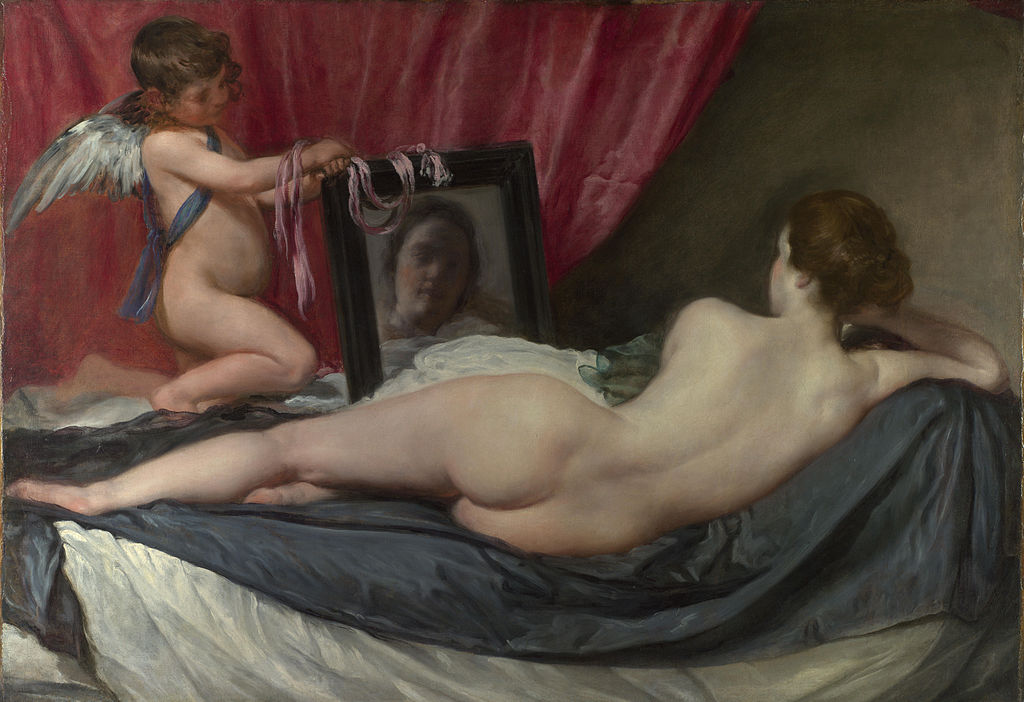
    Sometime a work of art becomes implanted in our mind because we find it disturbing. Not that we do not acknowledge its greatness, the artistic grandeur and the stylish finesse, but there is something about it that touches us in an unpleasant way, evoking discomfort, perhaps even anxiety. When I first saw the Rokeby Venus (known as ‘The Rokeby Venus’ since it was part of an art collection in Rokeby Park) I felt some agitation, and simply couldn’t figure out where it was coming from. Venus, as we all know, is the embodiment of love and beauty, and is often depicted in works of art. But the Rokeby Venus, a huge picture covering an entire wall at the National Gallery, created a strange turmoil.

    The Spanish painter Diego Velázquez (1599-1660) painted the female nude in spite of the vehement opposition of the Spanish Inquisition. He created this painting between 1647 and 1651, and was determined to depict the female body in the most realistic and vibrant manner.  In a way, this picture is an attempt to address human sexuality – not in a vulgar way, but through a portrayal of the most exquisite female ideal. Venus, the Roman goddess of love, beauty and fertility, is recumbent on a couch, watching a mirror – two gestures typical of her depiction in art – as Cupid, her son and the god of physical love, holds the mirror in front of her. Though she appears to be gazing at herself at the mirror, her eyes reveal that she is, in fact, watching the viewer.

    Art historians often argue that the distinct nature of the picture derives from its simplicity – it has no embellishments and hardly any decorations. Both Venus and Cupid are portrayed very realistically, a woman and a young boy on a couch.

    I tend to disagree with this argument. Indeed, there are no jewels and accessories, yet the embellishment—almost adoration—of the female body is embedded in the exposition itself: Venus’s naked body is set on a black sheet placed over a white one. The black sheet, as is often noted, follows her body contours. The couch almost evokes an association of a shrine. It seems to me that Velázquez went out of his way to illustrate the beauty of the female body.

    So why did I find the picture so unsettling? After many deliberations I came to the conclusion that it includes two distinct perspectives: one feminine and the other masculine. They co-exist, creating an inner tension, which makes the viewers stare relentlessly at the painting.

    From a masculine perspective, Venus’s beauty is overwhelming. The delicate contours, the rosy undertones, the pale back, the light neck and temple, suggesting purity in spite of her sensual posture, the naked body contrasted with the black sheet – an ode to feminine perfection. This Venus is the embodiment of sublime seduction.

    Yet, examining the picture from a feminine outlook is an altogether different experience. First, there is the mirror. Venus seems unable to look at her body; she is gazing only on her face. Why isn’t her entire figure reflected in the mirror, but only the facial features? To me, it is nearly a feminist declaration: women find it hard to watch their naked body. Endless hours spent in front of the mirror are always about: do the clothes flatter me? Is the makeup right? Can my flaws be seen through the dress? Velázquez is depicting feminine estrangement from simple, straightforward female nudity. Men adore Venus’s naked body, but she is unable to look at it herself.

    To emphasize her inability to look at herself, even when she watches her face in the mirror, she appears to see nothing but a blurred image, with uneven colors. And a close examination of her gaze, which should have been directed forwards, reveals that it is traveling to the viewer. In essence, it is a portrayal of a beautiful woman who is unable to look at her body and face and see its allure.

    And also, her beautiful body is placed on the black sheet as if it were an object. We don’t really see her facial expression, thus her emotions remain concealed. If we ignore for a moment that it is Venus, and imagine, for the sake of the argument, that this picture was created in the 21st century, we would probably perceive it as chauvinistic.

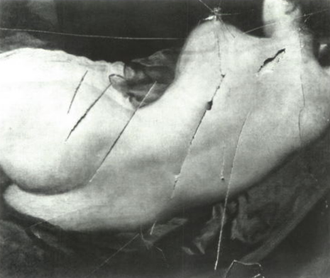
    So which perspective should we adopt? The feminine or the masculine? They are both there, within the picture, evoking two contrasting sets of emotions. Most viewers look at it bewildered, admiringly yet with some unease.  In 1914 an English suffragette slashed the picture with a knife, badly damaging it.

    Velázquez was, I believe, a man ahead of his time. His intricate, complex drawing of female nudity, in spite of the Inquisition’s threats, reveals a desire to address the psychological aspects of female and masculine sexuality, to outline the difference between them. The hazy face in the mirror, with the eyes secretly watching the observer, may well have been one of the earliest manifestations of modern feminism.