Tag: religion

  • The Pope and the Nazis

    The Pope and the Nazis

    Pope Francis’s attempts to direct the Catholic Church into a more progressive path brings his influence into question. As a spiritual leader of millions, to what extent can he change both the church and the world? His believers live in different places around the globe, speak many languages, belong to various cultures, yet they all look up to him as the ultimate moral authority. Can a leader without an army, so to speak, be as influential as political leaders? And what happens if national sentiments stand in contrast with religious faith?

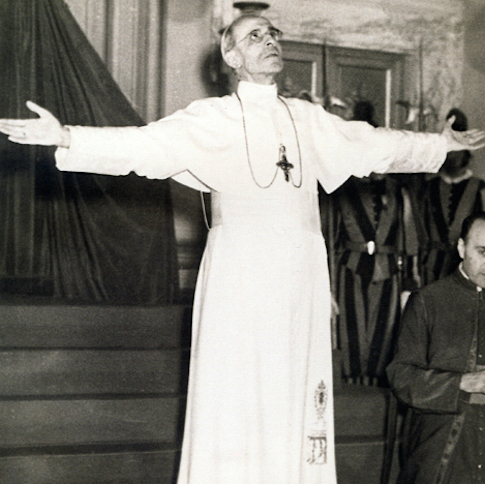
    Early in 1963 The Deputy, a play written by the German playwright Rolf Hochhuth, was staged in Berlin. It was the first time concentration camps were presented onstage, which at the time provoked fierce protests. But this wasn’t the only objection to the play; its theme could not be tolerated by many: it blamed Pius XII, the Pope during World War Two, for not taking public action against the unfolding of the Holocaust. According to Catholic dogma, the Pope is the deputy of Christ on earth, and his lack of action is interpreted in this work in religious terms.

    The play is most unusual. It combines two genres we see as conflicting: a historical play and a religious work of art. Hochhuth presents concrete historical arguments within a religious framework. Doctor Mengele is a modern manifestation of the devil, and Auschwitz is his way of provoking God. As Satan tries to annihilate life, the divine creation, the author articulates his historical insights—and his reservations about Pius XII.

    The Nazis intentionally avoided an open rift with the Roman Catholic Church, argues Hochhuth in the historical notes added to the play. In spite of their obvious ideological objection to Judeo-Christian tradition, some Nazi leaders had ambivalent feelings towards Catholicism. Hitler’s mother, we are reminded, was a devout Catholic and attended church regularly with her children. Also, many German soldiers were Catholic. A public attack on the Pope and the Church might generate a sense of alienation, perhaps whilst in battle—a most undesirable result that may weaken Germany. Thus, the Nazi leadership wished to blur its alienation from the Church, at least until the end of the war.

    This made the Pope extremely influential, argues Hochhuth. Had he voiced a clear and unequivocal condemnation of ‘the final solution,’ the Nazis may have reconsidered the plan to exterminate European Jewry. But Pius XII refrained from condemnation. In the play, his reasons are both practical and theoretical. From a practical perspective, the Nazi regime is the only impediment to the spread of the anti-religious ideology: communism. Also, the Church must keep its neutrality since its believers are on both sides. And possibly more Jews could be saved if an open conflict with Nazi leadership is averted.

    The play also ascribes to Pope Pius XII profound theoretical arguments: protecting the Roman Catholic Church is his ultimate mission, worthy of any sacrifice. And there is a theological discussion on predestination and free will. “Was not ever Cain, who killed his brother, the instrument of God?” argues Pius XII. Hitler may be part of an obscure divine plan beyond our understanding.

    But what about the Jews? Hochhuth claims that this was the response of the historical Pius XII: “As the flowers in the countryside wait beneath the winter’s mantle of snow for the warm breeze of spring, so the Jews must wait, praying and trusting that the hour of heavenly salvation will come.”

    Many Catholics were deeply offended by the play. When staged in Europe and the United States, both Jewish and Christian protestors interrupted the show. Yet The Deputy is not at all anti-Christian. There are two saint-like characters that sacrifice their lives in the struggle with Nazism: a Catholic priest and a Protestant officer in the German army. The Catholic saint cannot endure the Pope’s moral stand. He thus shares the destiny of the Jewish victims and joins them in Auschwitz. To break his spirit Mengele makes him remove bodies from the crematorium. This drives him to desert his way of passive resistance to Nazism and try to murder Mengele, who then kills him. The Protestant saint is a man of action. He impedes Nazi plans to speed up the extermination of the Jews. He is a Christian, he says, because he is “a spy of God”—a man engaged in action aimed at saving lives, changing the route of history.

    At this specific point in history, the Pope could have transcended his role as the head of the Catholic world and spoken against universal crimes, but Pius XII chose to defend Catholicism rather than fulfill the moral obligation of being a deputy to God. Unlike some junior priests who saved Jewish lives, he kept quiet, doing nothing to stop the Holocaust.

    Many questioned his motivations.

  • Is Religion Reversible?

    Is Religion Reversible?

    Mircea Eliade (1907-1986) is the most prominent twentieth-century scholar of comparative religion. Human existence, he argues, has two separate realms: the sacred and the profane. Each has its unique nature and characteristics, and also a different understanding of time. Profane time is a chronological development from past to present, and then to the future. Religious time is something else: when taking part in a religious ceremony, it is possible to experience divinity with the same emotional intensity as when that religion was created. Thus, the boundaries of ordinary time are exceeded, and men connect with God as they did in Illud tempus, ‘times of origins’, when religions were created. For example, a Christian participating in the mass may feel the presence of Christ just as his followers in the first century did. He may believe his miracles can be extended to him personally. If he is sick, Christ can heal him. Thus, within the religious experience, it is possible, even if only to some extent, to go back in time.

    In spite of Eliade’s unique contribution to religious studies, he was not the first to contemplate on this aspect of religion. Fyodor Dostoevsky published his masterpiece The Brothers Karamazov in 1880. One chapter, The Grand Inquisitor, can be read separately from the novel. It is a short tale – some call it a parable – describing a most unusual event: Christ comes back to earth for a short visit, at the time of the Spanish Inquisition. Appearing in Seville, he performs several miracles – healing the sick, reviving a dead young girl. People immediately recognize him; they are completely taken by his goodness. But as they follow and adore him, in comes the much-feared Grand Inquisitor, after executing some heretics. He arrests Jesus and sentences him to be burnt the next day. His fault, says the Inquisitor, is that his short visit to earth only interferes with the Church’s mission; he is no longer needed here.

    This brilliant and complex short story can be interpreted is many ways; one reading focuses on the question of religion and time. If the events that formed the birth of Christianity were repeated centuries later, would they carry the same religious significance? Or, to put it more generally, are monotheistic religions a changing spiritual phenomenon, created and then gradually transformed over time, or do they maintain a fundamental unchanged belief? Dostoevsky, as always, provides a complex and intriguing answer.

    When it comes to a personal encounter with the divine, this short masterpiece suggests that people today would be drawn to believe in Christ and follow him exactly as they did in the first century: “”He comes silently and unannounced; yet all—how strange—yea, all recognize Him, at once! The population rushes towards Him as if propelled by some irresistible force; it surrounds, throngs, and presses around, it follows Him…. He extends His hands over their heads, blesses them, and from mere contact with Him, aye, even with His garments, a healing power goes forth.” Christ would probably evoke the same spiritual enthusiasm as he did two thousand years ago.

    However monotheistic religions are also institutions; congregations, leaders who often have extensive political power, common practices, taxes and wealth, and perhaps more than anything, the transformation of primal religious events into a comprehensive way of life. Here, argues the Inquisitor, time cannot be turned back. Religion as a way of life evolved over time, creating different set of customs and rules, sometimes utterly remote from those prevailing in the ‘times of origin’.

    In fact, the Inquisitor’s argument is even more radical: Jesus liberated man by inspiring the hope of happiness generated by free will, of preferring good to evil. Yet true human happiness is the very opposite, a result of lack of choice: “We will prove to them their own weakness and make them humble again, whilst with Thee they have learnt but pride, for Thou hast made more of them than they ever were worth. We will give them that quiet, humble happiness which alone benefits such weak, foolish creatures as they are, and having once had proved to them their weakness, they will become timid and obedient, and gather around us as chickens around their hen.” Clearly, with this skeptical view, the Inquisitor sees Christ as an intruder; he set in motion a historical process that the Church attempts to correct. He created expectations that could never be met, leading to nothing but disappointment.

    So how does the story end? Is Christ executed again? Of course not, that would be a revival of ‘time of origin’; the Inquisitor wouldn’t want that. Christ remains silent all through the story. “The old man longs to hear His voice, to hear Him reply; better words of bitterness and scorn than His silence. Suddenly He rises; slowly and silently approaching the Inquisitor, He bends towards him and softly kisses the bloodless, four-score and-ten-year-old lips. That is all the answer. The Grand Inquisitor shudders. There is a convulsive twitch at the corner of his mouth. He goes to the door, opens it, and addressing Him, ‘Go,’ he says, ‘go, and return no more… do not come again… never, never!’ and—lets Him out into the dark night. The prisoner vanishes.”

    ‘And the old man?’

    ‘The kiss burns his heart, but the old man remains firm in his own ideas and unbelief.’”